If you’re evaluating T700 elongated carbon fiber paddle manufacturers for your brand, retail line, or distribution program, you already know the basics. You know T700 is the carbon fiber benchmark. You know elongated shapes drive the pro-tier market. What’s harder to find is a manufacturer who handles both variables together — and does it consistently across thousands of units.
This guide is written from the factory floor. We’ll walk through what a real T700 elongated paddle looks like in production, what to verify before placing your first PO, and where this category sells best in 2026.
What Defines a True T700 Elongated Paddle?
Two specifications. Both often misrepresented by suppliers. Both worth separating before you compare quotes.
T700: A specific grade of standard-modulus carbon fiber developed by Toray Industries, with a tensile strength of approximately 4,900 MPa. Originally engineered for aerospace applications. Not a brand name, not a marketing label — a defined material standard with a public datasheet.
Elongated: A paddle shape with a length-to-width ratio that pushes toward the 17-inch length limit set by USA Pickleball. Typically 16.5″+ in length with a face width of 7.0–7.5″. Designed for reach, leverage, and a higher sweet spot.
Many factories can produce a “carbon fiber long paddle.” Far fewer can produce a true T700-spec paddle in a true elongated geometry — with the lay-up architecture and weight distribution that pro-tier buyers expect. For B2B sourcing, treating these as two separate audit criteria saves a lot of returns down the line.
T700 vs T800 vs 18K — Choosing the Right Carbon Grade for Your Elongated Series
Before we get into manufacturing, you need to decide which carbon grade fits your retail positioning. This is where most brand owners over-spec or under-spec their first run.
Material Grade Comparison Table
| Property | T300 | T700 (industry baseline) | T800 | 18K (weave format) |
| Type | Standard modulus | Standard modulus | Intermediate modulus | Weave density (not a grade) |
| Tensile strength | ~3,530 MPa | ~4,900 MPa | ~5,490 MPa | Depends on base material |
| Tensile modulus | ~230 GPa | ~230 GPa | ~294 GPa | Depends on base material |
| Relative cost | Baseline | ~40–50% over T300 | ~25–35% over T700 | Premium from confusion |
| Elongated fit | Not recommended (too soft) | Best fit | Flagship tier | Depends |
| Typical retail tier | $40–70 | $80–150 | $150–250+ | Varies by brand |
One important clarification: 18K is not on the same axis as T700/T800. “18K” describes weave density (18,000 filaments per tow), while the T-series is a material grade. Markets often position “18K paddles” as superior to T700 — but an 18K weave can be made from T300 or lower-grade fiber.
B2B buyers should require suppliers to disclose both the material grade (T-grade) and the weave count (K-count), not just one.
Which Grade Fits Which Retail Tier?
- T700 + 16mm elongated carbon fiber paddle: The most common configuration in the mid-to-upper tier ($80–150 retail). This is why T700 + 16mm thickness remains the safe starting point for brands building an elongated line.
- T700 + 14mm: Power-oriented elongated, $90–140 retail.
- Full T800 build: Flagship tier ($180+), positioned for “pro player” or “tennis crossover” sub-lines.
- T700 face + T800 reinforcement strips: A common hybrid engineering approach that balances stiffness and cost.
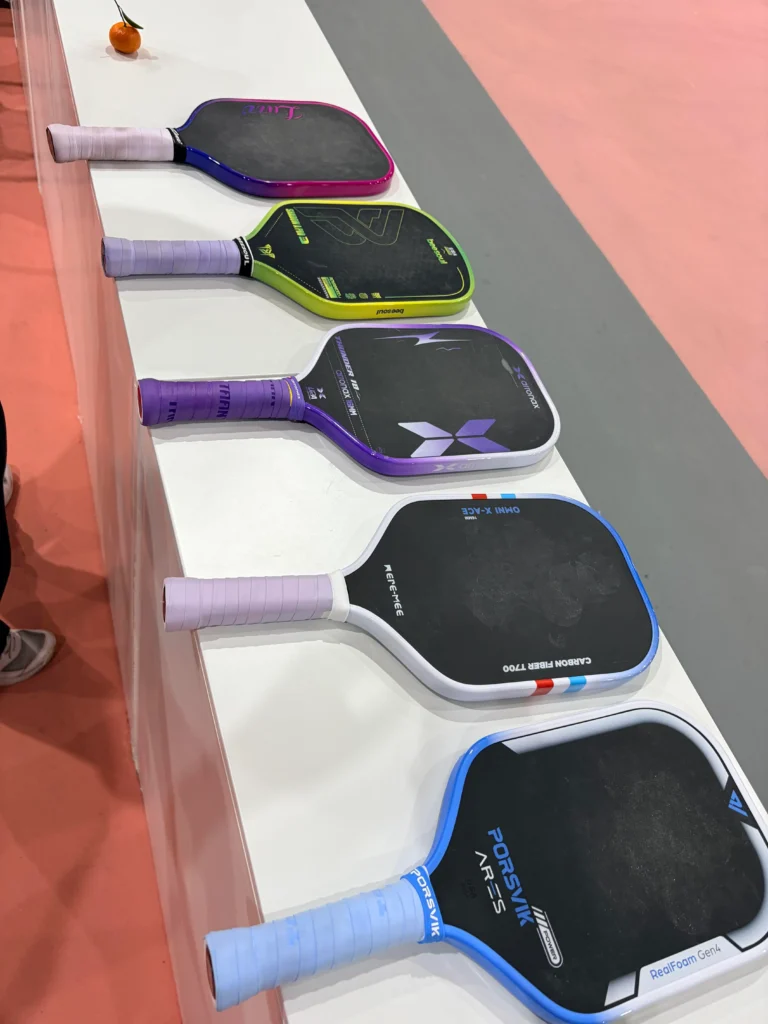
You can see how these grades translate into actual products in our full carbon fiber pickleball paddle line.
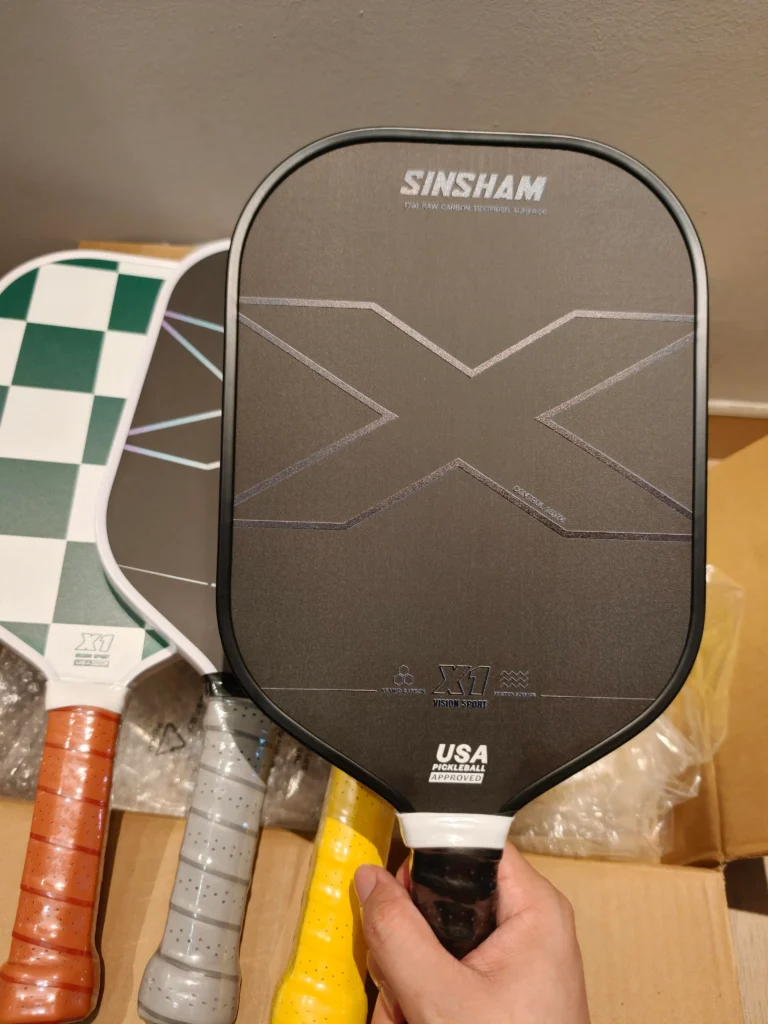
Why T700 + Elongated Is Harder to Manufacture Than It Looks
Each variable on its own is well understood. Combined, the engineering complexity scales up sharply. Below are the three manufacturing challenges B2B buyers most often miss when comparing quotes.
The Torsional Stability Problem in Long Shapes
As paddle length approaches the 17″ limit, torsional stiffness along the long axis drops measurably. In plain terms: the longer the paddle, the more it twists on off-center contact, and the more “soft” or “wobbly” the player feels at impact.
T700’s high tensile strength, paired with a correct 0°/45°/90° lay-up architecture, can offset this. But if a factory uses T300 or low-grade carbon to save material cost, the torsional weakness shows up at the production-batch level — as elevated returns and complaints from end players.
Why Low-Grade Carbon Fails on Elongated Builds
Widebody paddles can tolerate T300 because the shorter length means a shorter lever arm, masking the stiffness deficit. Elongated geometry amplifies it. Common cost-cutting practices we see in the industry:
- Carbon-fiberglass blending: Slipping fiberglass layers between carbon plies (visually hard to detect) — stiffness collapses immediately.
- T300 sold as T700: Without Toray purchase records, there’s no way to verify the actual grade.
- Simplified lay-up angles: Skipping the 45° plies and stacking only 0°/90° — torsional performance drops a tier.
In the past 12 months, we’ve reverse-tested 10 competing “T700 elongated” samples submitted by clients during factory transition projects — 2 contained T300/T700 mixed lay-ups, and 2 had glass fiber layers between carbon plies.
Batch Consistency: The Hidden B2B Risk
Elongated swing weight ranges 15–20% wider than widebody. The same process tolerance that’s invisible on a widebody becomes a customer-facing problem on an elongated. A widebody factory holding ±0.3 oz weight tolerance can ship without complaint. The same factory making elongated paddles will produce noticeable unit-to-unit variance — players will say “this one feels different from the last one.”
A qualified T700 elongated factory should hold batch weight tolerance under ±0.15 oz and swing weight under ±5 units.
Across 2025, our T700 elongated batches held the following pass rates:
| Metric | Apexonsport (2025) | Industry typical |
| Weight tolerance ±0.2 oz | 98.7% | 85–90% |
| Swing weight ±5 units | 95.4% | 85–89% |
| Surface roughness compliance | 98.2% | 90–95% |
How to Vet T700 Elongated Carbon Fiber Paddle Manufacturers: A 7-Point Checklist
Use this checklist directly when evaluating any T700 elongated factory. Suppliers who can answer all seven points cleanly are rare — and the gap between them and “rebadge assembly shops” shows up in your reorder rate.
- Toray purchase records — Can they provide scanned invoices from Toray or an authorized distributor for the past 6 months? This is the most direct way to verify T700 authenticity.
- Lay-up disclosure — Will they share the specific lay-up sequence (e.g., 0°/45°/-45°/90° ply count and order) under NDA? Factories that refuse usually didn’t design the lay-up themselves.
- In-house tooling — Are mold cutting and modifications done internally, or outsourced? Outsourced tooling extends sample lead time to 15+ days.
- QC test scope — Do they run unit weight, swing weight, deflection, and surface roughness (against USAPA Rz/Rt limits)? Factories that “eyeball and weigh” struggle with batch consistency.
- USAPA pre-test capability — Can they run pre-test to USA Pickleball Equipment Standards on calibrated equipment before official submission? This eliminates 1–2 cycles of test failure.
- MOQ flexibility — Will they accept first orders at 50 units? Most rebadge shops require 300–500+ MOQ because they cannot maintain process consistency at small volumes.
- Sample lead time commitment — Can they deliver standard-spec samples in 3–7 days? Anything slower means tooling or material is not in their own hands.
If you want a broader factory-evaluation framework that goes beyond T700 elongated specifically, see our Best Pickleball Paddle Manufacturer Sourcing Guide — it covers 30+ vetting dimensions including certifications, capacity, shipping terms, and knowledge transfer, which are particularly useful for brands building a private label elongated pickleball paddle line.
Inside Our Production Line — How Apexonsport Builds T700 Elongated Paddles
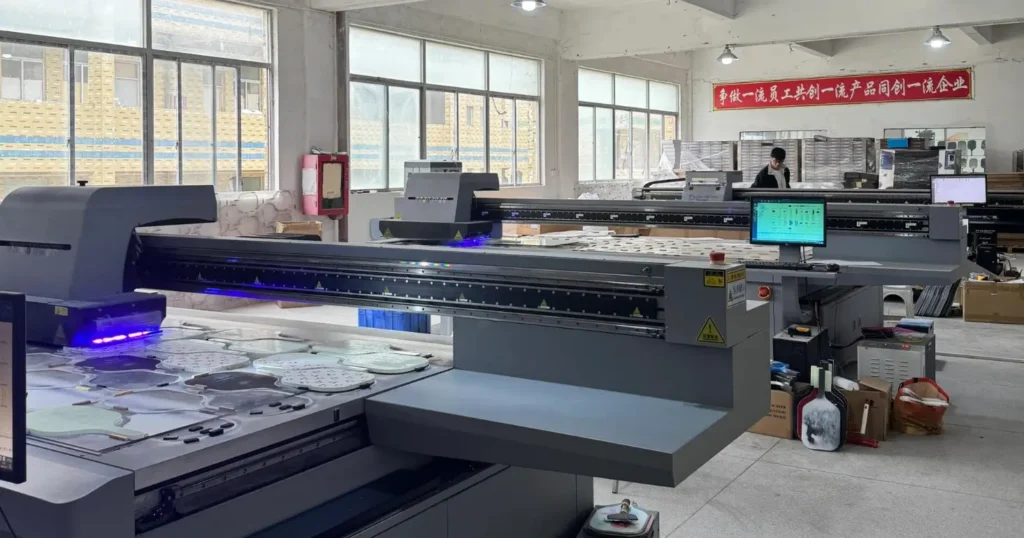
Among T700 elongated carbon fiber paddle manufacturers, Apexonsport specializes in thermoformed production for this exact category. Below is how we run the same checklist on our own line — going through prepreg, mold, lay-up, thermoforming, CNC, and QC in order.
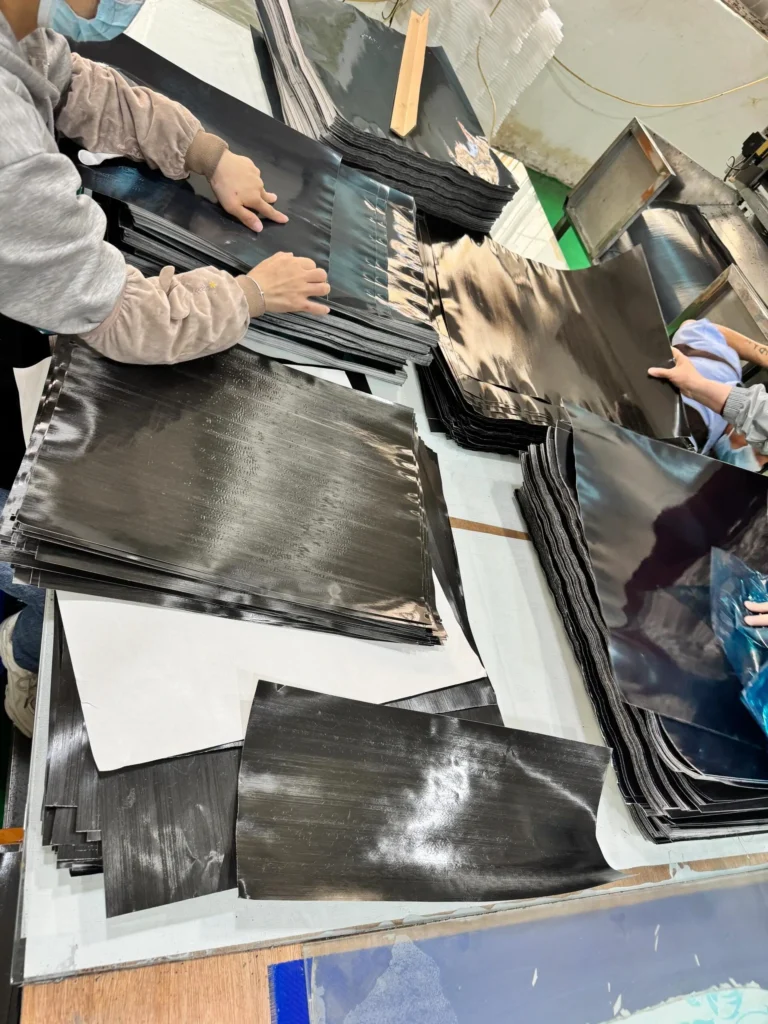
Prepreg Sourcing & Lay-Up Architecture
We source T700 prepreg directly through Toray-authorized channels. Every roll arrives with a Toray batch number traceable to a specific production line. For T700 raw carbon fiber paddle OEM projects, every input is bound to a batch ID in our internal ERP — your shipment can be traced back to the exact prepreg roll used.
Our standard elongated lay-up is a 6-ply structure: surface 0° / inner 45° / -45° / 0° / 90° / surface 0°. The 45° plies are the controlling element for torsional stiffness on elongated geometries. Factories that omit them cannot deliver a properly performing long paddle.
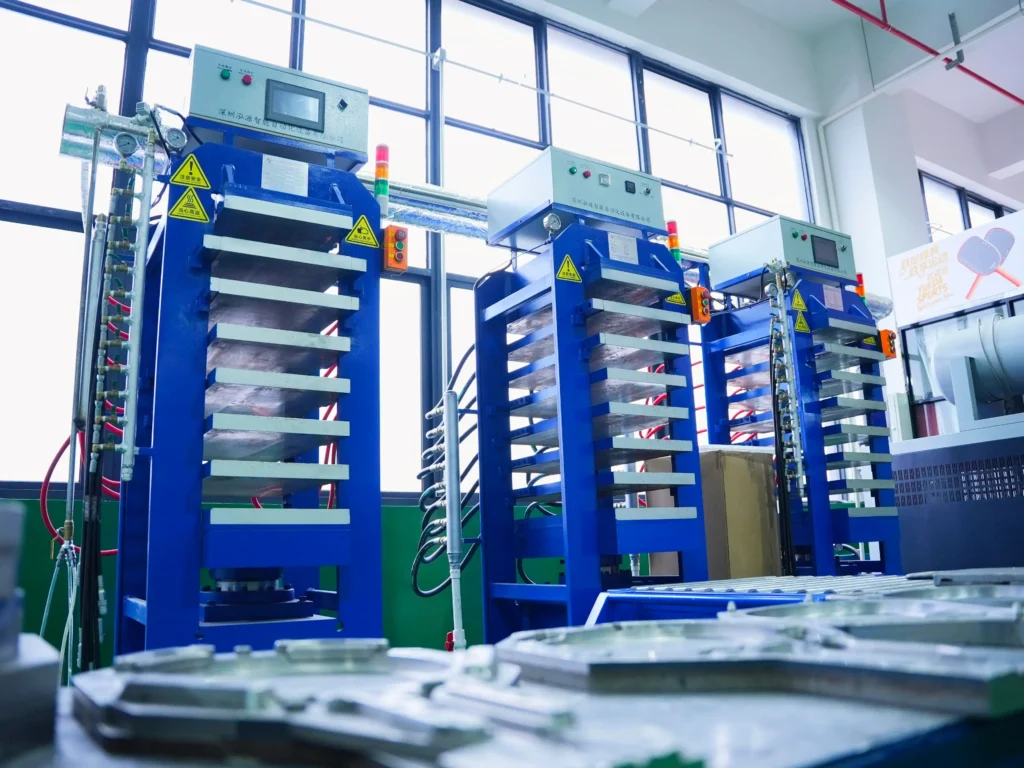
Thermoforming & Mold Tolerance
Our thermoformed pickleball paddle line uses fully closed-mold thermoforming — not open-mold cold press followed by edge bonding. Closed-mold processing increases edge composite density by approximately 18%, which structurally addresses the throat-area cracking that elongated paddles are most prone to. Mold tolerance is held within ±0.05 mm and re-verified on a CMM every six months.
In-House QC Before Every Batch Leaves the Line
Every T700 elongated batch passes through: unit weighing (±0.2 oz tolerance), swing weight test (±5 unit tolerance), deflection test (using equipment matched to USAPA protocol), and surface roughness inspection (10% sample rate per batch).
Production Batch Snapshot — March 2026
- Quantity: 800 units
- Client type: North America DTC brand
- SKU: T700 16mm Elongated (16.5″ L × 7.4″ W)
- Weight tolerance pass rate: 97.1%
- Swing weight pass rate: 97.2%
- Surface roughness pass rate: 100%
- Returns: 0%
Regional Market Insights — Where T700 Elongated Paddles Sell Best
As a factory shipping to North America, Europe, and Southeast Asia simultaneously, the section below is our first-hand read on current wholesale and retail dynamics.
North America — The Mature Market
The largest market for T700 elongated paddles. Retail price ranges are widest ($80–250) and channel structure is the most layered (Amazon FBA, DTC websites, specialty retailers, pickleball-only chains like Pickleball Central). North American buyers are highly sensitive to “USAPA approved” labeling — uncertified products struggle to scale on Amazon.
Recommendation: Build USAPA certification into your launch timeline from the start, not as an afterthought.
Europe — Certification & Packaging Sensitive
Germany, France, and the Nordics are growing fastest. This market is more strict than North America on packaging environmental credentials (FSC-certified cartons, minimal single-use plastic) and product certifications (CE marking, REACH compliance). Retail leans mid-tier (€60–120), and channels are dominated by sports-specialist distributors rather than direct DTC.
Recommendation: Treat eco-packaging and REACH documentation as baseline, not add-ons, when entering Europe.
Southeast Asia — Volume-Driven & Price-Sensitive
Singapore, Malaysia, Thailand, and Vietnam are among the fastest-growing pickleball markets, but with higher price sensitivity than North America. Entry-level T700 elongated paddles ($40–70 retail) are the volume drivers; flagship tiers are slow movers. Channels are e-commerce-led (Lazada, Shopee) plus club bulk orders.
Recommendation: Position “T700 entry-level elongated” as the traffic SKU, and hold higher tiers for 1–2 years until the market matures.
Working with Apexonsport: How to Start a Sample
Whether you need small-batch T700 raw carbon fiber paddle OEM samples or custom T700 paddle wholesale production runs, the workflow is the same:
- Inquiry: Send your target specs (length, width, thickness, weight, surface, color, logo). We respond with a spec sheet and preliminary quote within 24 hours.
- Spec alignment: 1–2 rounds to confirm lay-up, edge guard, handle length, and grip wrap details.
- Sampling: Standard-spec samples in 3–5 days; custom geometry or custom lay-up samples in 5–7 days.
- Production: Mass production lead time 7–15 days depending on quantity and surface finish. FOB Shanghai port standard, other terms negotiable.
The full inquiry-to-production workflow is documented on our custom pickleball paddle page.
MOQ: 50 units. This sits at the low end of the industry — most rebadge shops require 300–500+ because they cannot maintain process consistency at smaller volumes.
Frequently Asked Questions
Q1: What is your MOQ?
50 units. The 50 can be a single SKU or 2–3 SKUs combined (color variants, surface finish variants).
Q2: What are your sample and production lead times?
Standard-spec samples 3–5 days. Custom geometry or custom lay-up samples 5–7 days. Production 7–15 days, depending on quantity and surface complexity. We use DHL or FedEx for samples.
Q3: Do you support full ODM (custom shape, core, lay-up)?
Yes. Our in-house engineering team can reverse-engineer lay-up and swing-weight distribution from a target feel brief (power-oriented, control-oriented, or balanced). NDA and IP terms are signed at the start of engagement.
Q4: Do you assist with USAPA submission?
Yes. We pre-test on USAPA-protocol-matched equipment to minimize submission failures, and we handle sample dispatch, follow-through, and documentation.
Q5: What shipping terms do you support?
FOB Shanghai/Ningbo (default), CIF US West/East Coast ports, and DDP (recommended for first-batch launches).
Q6: What’s the real difference between T700 and T800 in elongated paddles?
On 16.5″+ elongated geometries, T800 delivers approximately 25–28% higher torsional stiffness than T700, with better swing stability — but cost is 25–35% higher. Recommendation: T700 for $80–150 retail core SKUs, T800 for $180+ flagship tiers.
Q7: What weight tolerance can you hold on elongated batches?
Our standard is ±0.15 oz. This sits in the top 10% of the industry — most factories making elongated paddles run ±0.3–0.4 oz tolerance.
Q8: Do you support private label elongated pickleball paddle production? What’s the MOQ?
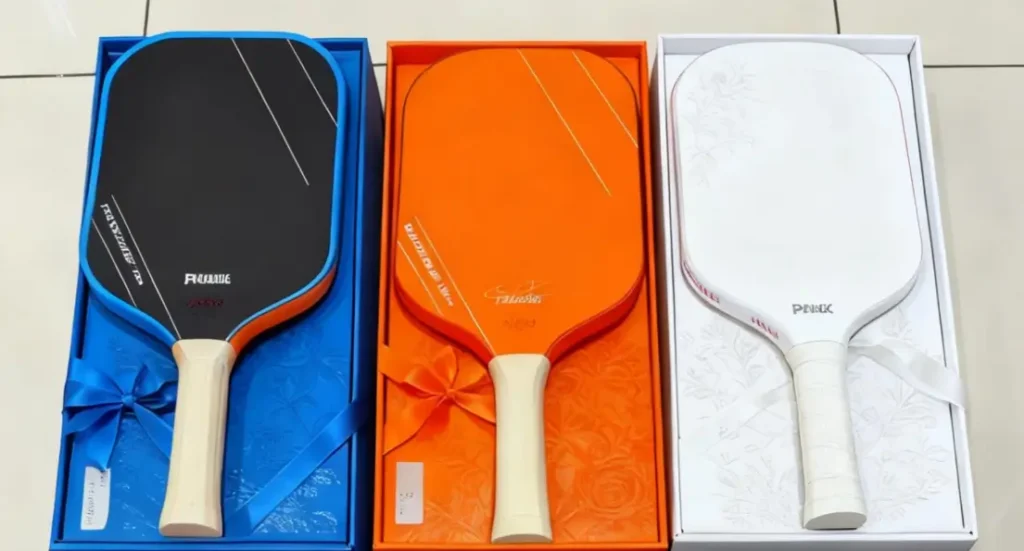
Fully supported. We run private label programs for multiple brands across North America and Europe, including logo printing (UV, silk-screen, heat transfer), custom colorways (up to 6 colors per side), and custom packaging (boxes, hangtags, manuals). Private label MOQ matches standard OEM at 50 units.
Q9: Do you offer exclusive regional distributorship?
Single-brand exclusive distributorship is evaluated case by case — annual purchase commitment, market roadmap, and brand positioning are the core criteria. To open this conversation, reach us via our factory contact page.
Closing Note
The barrier for T700 elongated carbon fiber paddle manufacturers isn’t the concept — it’s the process consistency. The gap between a factory that can show you Toray invoices, name their lay-up sequence, and hold ±0.15 oz batch tolerance, and a factory that just says “we use T700,” is a 5–10% return-rate difference on your next PO.
If you’re building a T700 elongated line for your own brand or distribution channel, we can take the spec, lay-up, and batch consistency conversations off your plate from the sample stage onward.