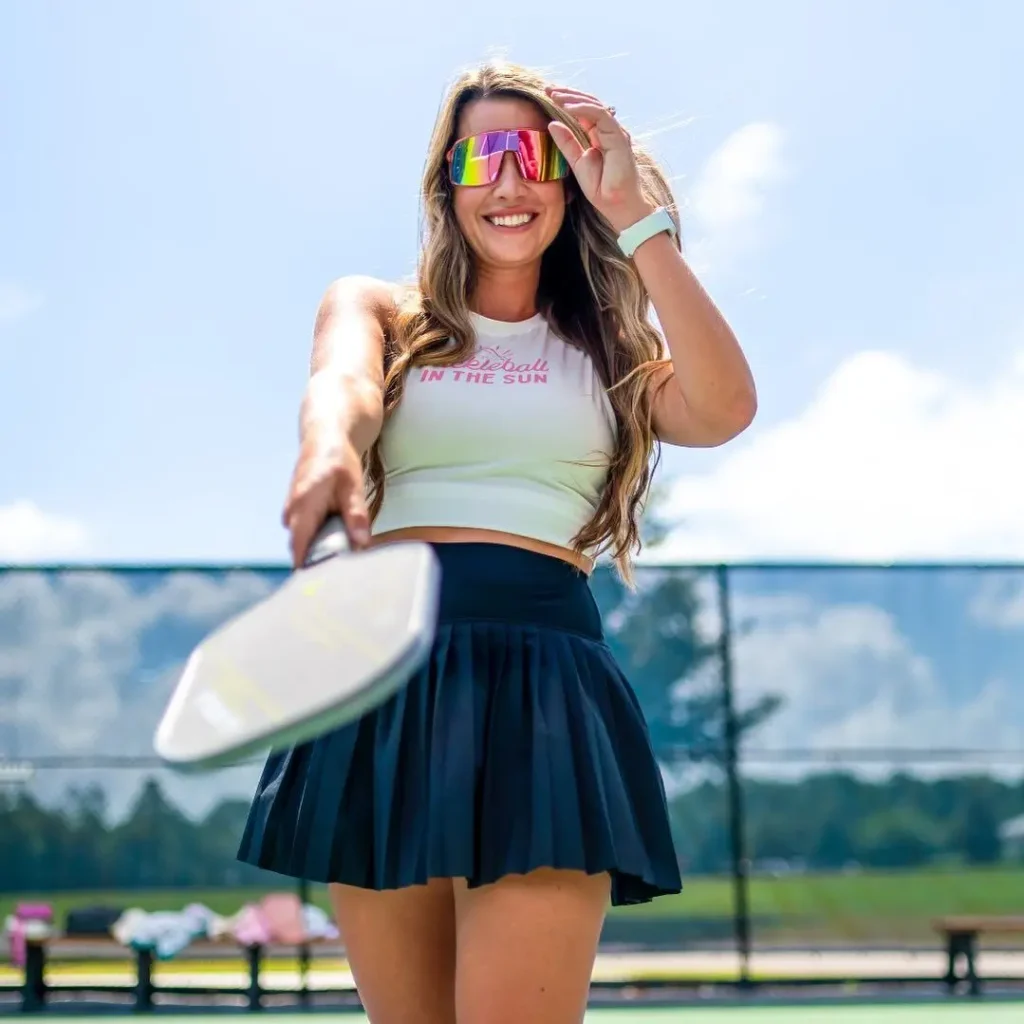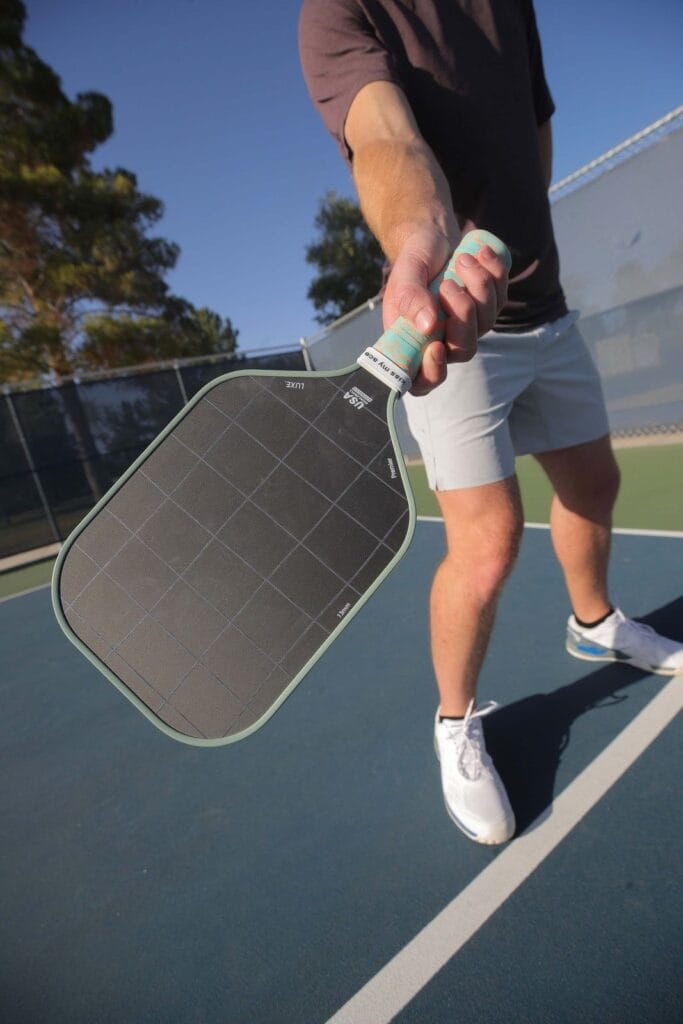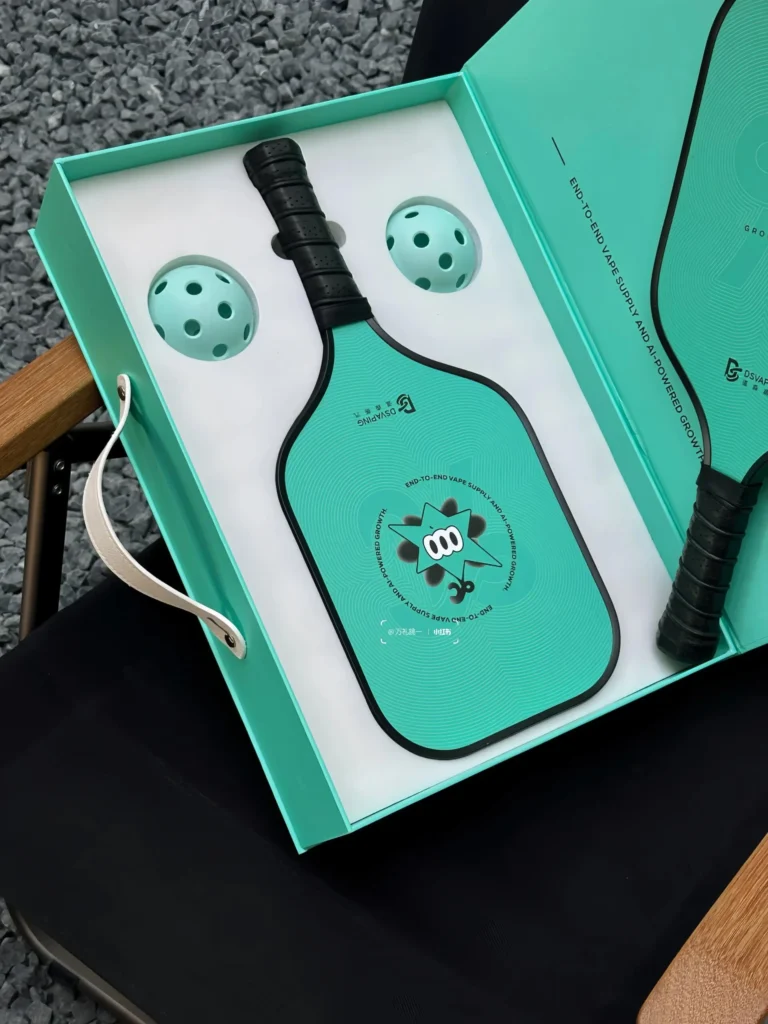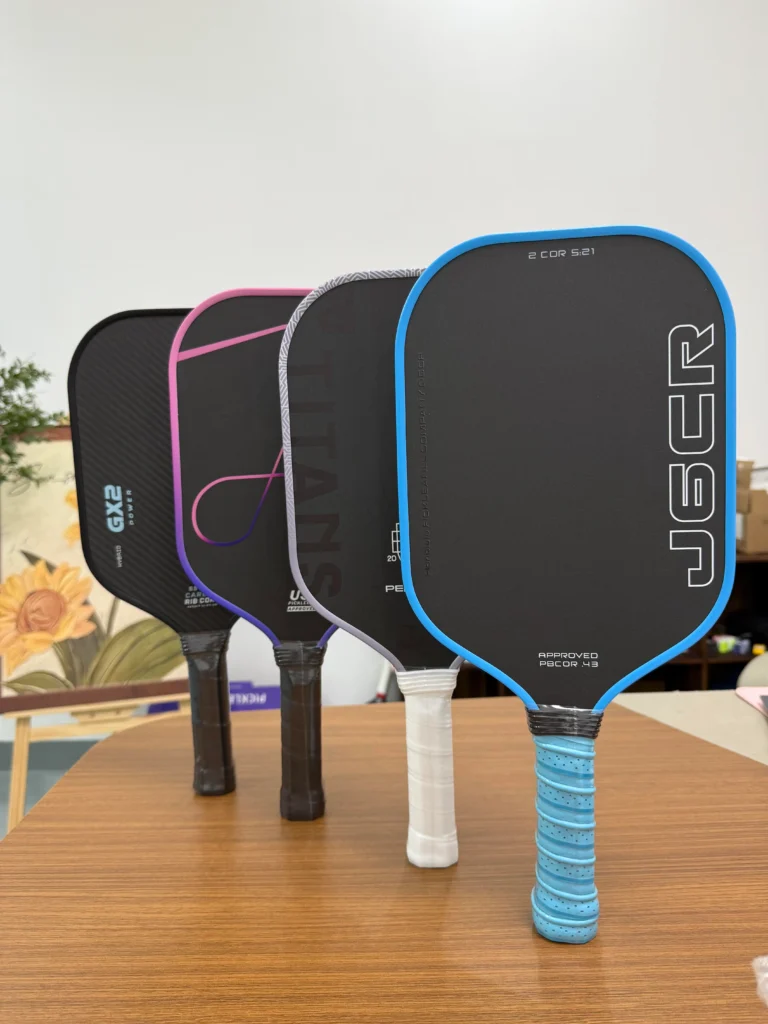
Private label pickleball paddles are paddles built in a factory to your brand’s specifications — your logo, your colors, your spec sheet, your packaging — then sold under your name, not the manufacturer’s.
At our factory, we produce private label paddles every week for new brand owners, established sporting goods distributors, pickleball clubs, and event organizers. The questions are almost always the same: What materials should I pick? How small can my first order be? What’s a realistic price per paddle? How do I make sure the second batch matches the first?
This guide answers those questions from the production line, not the marketing deck. If you’re evaluating whether to launch a private label paddle line — or comparing manufacturers — this is the factory-side context you need before you sign a PO.
What Are Private Label Pickleball Paddles?
Private label pickleball paddle: A paddle manufactured by a factory and sold under the buyer’s brand name, with the buyer controlling branding, design, and often the technical specifications.
Private label sits between two related models:
- OEM (Original Equipment Manufacturing): You provide the design and specs. The factory builds it exactly to your blueprint. Best for brands with a clear product vision.
- ODM (Original Design Manufacturing): The factory provides existing paddle designs. You pick a model, customize logo and colors, and launch faster. Best for brands testing the market.
Most “private label” projects are a hybrid — buyers start ODM (use a proven mold) and graduate to OEM (custom mold, proprietary core) as their volume grows.
Who buys private label paddles:
- Brand owners launching a pickleball line on Amazon or DTC
- Sporting goods distributors expanding their SKU range
- Pickleball clubs and academies producing club-branded gear
- Coaches and influencers monetizing their audience
- Tournament organizers and corporate event planners producing branded gifts
For wholesalers and brand owners who need batch-to-batch consistency at scale, the manufacturer choice matters far more than most buyers realize at the start. We’ll come back to that.
Cheaper vs Premium: How to Choose Your Paddle Spec
The single biggest decision in any private label project is where you sit on the cheaper-to-premium spectrum. That decision drives your unit cost, your retail price, your target customer, and your competitive position.
Here’s how the spec choices break down across the two ends of the market:
| Variable | Cheaper Option | Premium Option |
|---|---|---|
| Face material | Fiberglass / T300 carbon | T800 carbon / Kevlar / Titanium |
| Construction | Cold press | Thermoformed one-piece |
| Core material | PP honeycomb | EPP / MPP+EVA / EPP+EVA |
| Surface finish | Standard UV print | Sandblasted matte / Textured matte / Hydrographic |
| Personalization method | UV print only | UV print + Laser engraving + Labels combined |
Both ends have a market. The question is which one matches your brand position.
Face Material — Fiberglass to T800 Carbon & Kevlar
The face is what the ball touches and what the player feels first. From entry to elite, the typical ladder is:
- Fiberglass / T300 carbon — Soft, forgiving feel. Lower cost. Targets recreational players and entry-level retail (US$30–60 retail range).
- T700 raw carbon — The current mid-to-high market default. Strong spin, controllable touch, broad sweet spot.
- T800 carbon — Tighter weave, higher tensile strength. Premium tournament feel.
- Kevlar / Kevlar-carbon hybrid — Adds impact resistance and a distinctive muted sound profile. Used in top-tier paddles.
- Titanium-reinforced face — Niche premium positioning, enhanced structural feedback.
If you’re unsure where to start, T700 raw carbon is the workhorse for new brands targeting the US$80–150 retail range. We cover the full carbon range on our carbon fiber pickleball paddle page.
Construction — Cold Press vs Thermoformed One-Piece
Cold press: Face skins, core, and edge are bonded with adhesive under pressure. Lower tooling cost, easier small-batch production, classic “sandwich” feel.
Thermoformed one-piece: Face, core, and edge are heat-fused into a single unibody structure with foam-injected edges. Larger sweet spot, better durability, premium hand feel.
Practical implication for private label buyers:
- Cold press paddles are flexible. No mold investment is required, so you can run small batches and iterate quickly. This is the right choice for first orders, club paddles, and budget retail SKUs.
- Thermoformed paddles require a mold and a higher commitment, but deliver the unibody construction that mid-to-premium retail markets now expect. If you’re competing in the US$100+ retail range, thermoformed is increasingly the baseline. See our thermoformed paddle line for current Gen 4 specs.
Core Material — PP Honeycomb vs EPP / MPP+EVA
The core dictates the paddle’s pop, dwell time, and vibration profile.
- PP (polypropylene) honeycomb — Industry standard. Reliable, cost-effective, well-understood by the market. Used across virtually all entry-to-mid paddles.
- EPP (Expanded Polypropylene) foam core — Denser foam structure. Larger sweet spot, more consistent power across the face.
- MPP+EVA / EPP+EVA hybrid cores — Layered foam systems engineered for tournament-level control and reduced vibration. Used in flagship lines.
For most new private label projects, PP honeycomb is the safe starting point. EPP and hybrid foam cores are worth the upgrade once your brand is positioned above US$100 retail.
Surface Finish & Personalization Methods
This is where most new buyers underestimate the spec impact. The surface treatment is what the customer sees on the shelf and feels during the first hit.
- Standard UV print — Fast, inexpensive, full-color. Looks good in photos but feels flat under the hand.
- Sandblasted / textured matte — Slight grit for spin generation. Looks and feels premium.
- Hydrographic — Multi-layer printed pattern with depth. Strongest visual differentiation on retail shelves.
On personalization, cheaper SKUs typically use UV print only. Premium SKUs combine UV print + laser engraving + woven labels for a layered, retail-grade finish.
MOQ and Pricing: What to Expect at Each Order Volume
Minimum Order Quantities (MOQ) and per-unit pricing in this category vary widely depending on the manufacturer and the spec. Based on industry-wide ranges visible across major OEM suppliers in 2026:
| Order Volume | Typical Per-Unit Price (Thermoformed Carbon) | Best For |
|---|---|---|
| 4–20 pcs | US$30–50 / pc | Influencers, coaches, gift orders, club test runs |
| 50–100 pcs | US$28–45 / pc | New brand launches, market validation |
| 200–500 pcs | US$25–38 / pc | Established brands, regional distributors |
| 1,000+ pcs | US$24–30 / pc | National brands, large retail rollouts |
A few notes on these numbers:
- Cold press paddles run roughly 30–40% lower per unit than thermoformed at the same volume.
- Premium materials (T800 carbon, Kevlar, hybrid foam cores) push the per-unit cost up by US$5–15.
- DDP (door-to-door delivered) shipping adds freight, duties, and handling — get this quoted separately.
At our factory, MOQs start at 50 pcs per model. That threshold lets new brands run a credible market test without warehousing 500 paddles before they have customer feedback. With MOQs starting at 50 pcs and standard production lead times of 7–15 days, we support both pilot orders and large-scale rollouts. Detailed batch quotes are available on our wholesale page.
One of our wholesale partners — a regional sporting goods chain in the Philippine— started with a 50-pc test order on cold press paddles in March 2025. After the first batch sold through in 6 weeks, they reordered 250 pcs, then moved to thermoformed at the 600-pc tier within 9 months. The pattern we see most often: brands that start small, validate, then scale 3–8x within a year.
Lead Time and Production Workflow
A realistic timeline from first inquiry to delivered goods:
- Initial consultation & quote (1–2 days) — You share specs, target volume, branding direction. We quote pricing and lead time.
- Sample production (3–7 days) — A pre-production sample with your logo and chosen spec, for approval.
- Sample approval & PO confirmation (buyer-dependent) — You inspect, request changes, sign off.
- Bulk production (7–15 days for orders up to 1,000 pcs) — Cutting, layup, hot/cold pressing, edge trim, surface finishing, branding.
- In-house QC (1–2 days) — Weight, balance, surface flatness checks on every paddle.
- Packaging & shipping (1–3 days for prep, plus freight transit)
Total realistic timeline for a first private label order: 4–6 weeks from PO to delivery for sea freight, 3–4 weeks for air freight on smaller orders.
If a manufacturer quotes you a 7-day total turnaround on a custom thermoformed paddle, ask hard questions — that’s not enough time for proper QC.
Batch-to-Batch Consistency — The Hidden Make-or-Break Factor
This is the topic almost no manufacturer’s website talks about. It is also the #1 reason private label brands fail in their second year.
Here’s what happens: Your first batch arrives. The paddles feel great. Customers love them. You reorder a larger batch six months later. The new batch is slightly heavier. The pop sounds different. The grip circumference is off by 1mm. Customer reviews start mentioning “the new ones don’t feel like my old one.”
Brand trust takes years to build and a single inconsistent batch to crack.
What batch consistency actually requires from a factory:
- Weight tolerance control — Every paddle weighed off the line. Industry-standard tolerance is ±0.2 oz per paddle, batch average within ±0.1 oz of target.
- Balance point verification — Each paddle balanced and recorded. Inconsistent balance changes how the paddle plays.
- Surface flatness inspection — Visual and gauge checks for warping or surface irregularities.
- Locked material sourcing — Same supplier, same carbon roll batch, same resin system across reorders. Switching mid-program causes drift.
- Documented build specs — Written records of exact lay-up, cure temperature, press cycle for every model, so the second batch is built the same way as the first.
Our in-house QC team checks every paddle for weight tolerance, balance point, and surface flatness before it leaves the line. That’s table stakes for serious B2B work, but it’s not industry standard — many smaller suppliers spot-check, not 100% check.
When you evaluate a manufacturer, ask specifically: “What’s your weight tolerance per paddle? Do you check 100% of units or sample? Can I see your QC log from a recent batch?” The answers tell you everything.
Customization Options Beyond the Logo
“Private label” is often misunderstood as “factory paddle with my logo printed on it.” Real private label development covers far more:
- Paddle shape — Standard, elongated, widebody, hybrid. Each shape changes the playing profile and the visual identity.
- Length and width — Up to USAPA limits (17″ total length, 8.25″ width).
- Core thickness — Typically 13mm, 14mm, 16mm. Thicker = more control, thinner = more pop.
- Handle length and grip circumference — Two-handed players prefer longer handles; smaller hands need tighter grips.
- Edge guard — Standard plastic, foam-injected, or seamless thermoformed.
- Grip tape color and pattern — Often overlooked, but a strong brand cue.
- Butt cap design — Logo printing, raised emblem, or fully custom mold.
- Packaging — Polybag, branded sleeve, gift box, retail clamshell.
- Hang tags, instruction cards, warranty cards, accessories — All part of a complete retail-ready package.
The full list of what we customize — from logo customization to fully bespoke construction — is on our custom paddle page.
How to Choose the Right Private Label Manufacturer
Use this checklist when evaluating any private label paddle supplier:
- Are they a manufacturer or a trader? Ask for a factory address, ask for a video walkthrough of the production line. Traders mark up 10–25% over factory pricing.
- Do they specialize in pickleball or make every racquet sport? Specialization shows up in core density choices, surface texture quality, and shape library depth.
- Is there USAPA approval support? USAPA-certifiable construction matters if you plan to sell into tournament or club markets.
- What’s the actual MOQ — and does it match your stage? 50 pcs for a new brand, 200+ for established. Avoid manufacturers whose MOQ doesn’t fit your launch plan.
- Do they offer paid pre-production samples? A factory confident in its work will always sample before bulk.
- What’s their batch consistency policy? Specifically: weight tolerance, balance check, 100% vs. sample QC.
- Can they handle DDP / door-to-door shipping? Saves you significant logistics work if yes.
- Are they responsive within 24 hours? Long sales cycles need fast communication.
We cover our own factory profile, certifications, and production capacity on our about page.
In our experience, most first-time buyers focus their entire vetting process on unit price and lead time. They almost never ask, ‘What’s your weight tolerance per paddle?’ or ‘Do you have professional testing equipment in-house?’
At the ApexonSport facility, we lock in that crucial ‘batch consistency’ through a strict four-step system: rigorous material selection, standardized production SOPs, advanced machine testing, and meticulous manual inspection.
Take our advanced testing, for example: we run dedicated equipment to measure swing weight, PBCOR, balance points, and surface friction. Or look at our standardized production: during the thermoforming process, we precisely lay up four layers of carbon fiber and cure the paddle structure at exactly 180°C.
The buyers who throw these hard-hitting questions at us upfront are the ones still ordering from us three years later. The ones who gloss over these details are usually the ones who email us a year later, frustrated that their second supplier’s batch felt completely different from the first.
FAQ — Private Label Pickleball Paddles
What’s the minimum order quantity for private label paddles?
Industry MOQs range from 4 pcs (small-batch suppliers) to 500+ pcs (large factories). Our factory MOQ is 50 pcs per model, which balances market-test viability with credible per-unit pricing.
How long does private label production take?
Sample production is 3–7 days. Bulk production is 7–15 days for orders up to 1,000 pcs. Total timeline from PO to delivered goods is typically 4–6 weeks including freight.
Can my private label paddles get USAPA certification?
Yes, if the paddle is built to USAPA dimensional and material standards. Certification is filed by the brand owner, not the factory, but we engineer to USAPA specs and provide documentation to support your application.
What’s the difference between OEM and ODM?
OEM means you provide the design and specs; the factory builds to your blueprint. ODM means the factory provides existing designs; you pick a model and customize branding. Most new brands start ODM and graduate to OEM as volume grows.
Can I customize the paddle shape, not just the logo?
Yes. Shape, length, width, core thickness, handle length, grip, edge guard, and packaging are all customizable. Custom shapes typically require a new mold and a higher MOQ.
Do you ship worldwide and handle DDP?
Yes. We ship globally and offer flexible logistics — FOB if you have your own freight forwarder, or DDP/CIF if you want a door-to-door delivered solution.
Private label is not a logo printing service. It’s a manufacturing partnership. The factory you pick at order #1 will define the consistency of orders #2 through #20 — and the trust your customers place in your brand.
If you’re ready to scope a project — spec, MOQ, timeline — start with a sample order and benchmark the build quality before committing to volume. That’s the lowest-risk way to validate any private label partnership.
“If you’re scoping a private label project, the lowest-risk first step is a paid sample. Send us your spec — face material, core, target weight, branding direction — and we’ll quote a sample within 24 hours, ship it within 3–7 days. You’ll have a paddle in your hand to evaluate before any bulk commitment.
Reach our B2B team:
WhatsApp: +86 198 5510 6759
Email: sales@apexonsport.com
MOQ: 50 pcs per model. Sample lead time: 3–7 days. Bulk lead time: 7–15 days.”