A carbon fiber pickleball paddle factory is a manufacturer that designs, layers, thermoforms, and inspects pickleball paddles in-house using carbon fiber face materials and polymer cores—from raw prepreg to packaged retail unit, all under one roof.
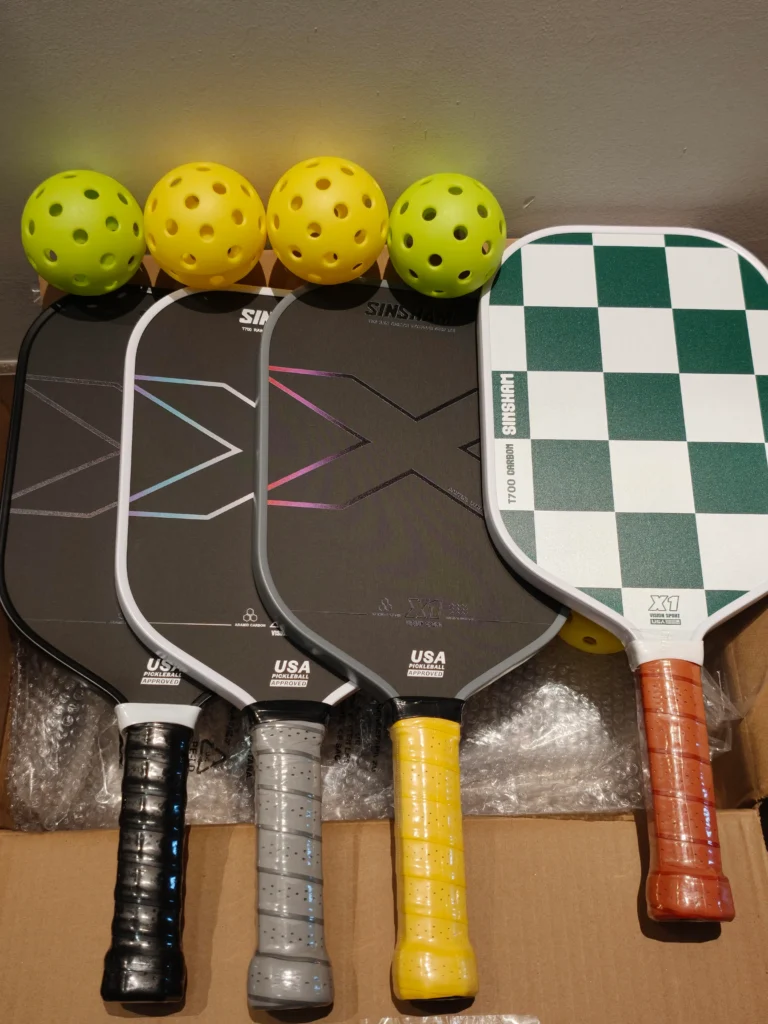
For brand owners and wholesalers in 2026, choosing the right factory is no longer about price alone. What actually drives retail return rates is process standards—carbon fiber layer count, material grade, batch consistency, and whether the factory can hand you verifiable test data. Get those wrong, and your customers will see Core Crush, Delamination, and Grit Wear within 3–6 months—and your brand pays for it on the warranty line.
This guide is written for B2B buyers who want to source directly from the production floor. We will show you what a real factory does differently, how to verify it, and what data you should ask for before placing your first PO.
What Is a Carbon Fiber Pickleball Paddle Factory?
A carbon fiber pickleball paddle factory is a vertically integrated production facility that manufactures pickleball paddles with carbon fiber faces and core systems—such as PP honeycomb, PP honeycomb + EVA, EPP + EVA, and MPP + EVA—in-house, from material cutting through final QC.
The key word is in-house. A real factory owns the prepreg cutting room, the layup tables, the thermoforming presses, the CNC edge stations, the paint booth, the QC lab, and the packaging line. Every step happens on one site under one quality system.
In 2026, more brand owners and wholesalers are sourcing direct from the production floor. The reason is straightforward: each extra layer between you and the manufacturer adds 8–15% to your landed cost and another layer of communication friction when something goes wrong on the QC report.
5 Hard Signals That Prove You Are Sourcing from a Real Manufacturer
Before you sign a PO, ask the factory to demonstrate these five things. If they cannot, stop and reconsider.
1. Live Production Video and Factory Tour Access
A real carbon fiber pickleball paddle factory will, on request, send you real-time video of its production line within 24 hours. They will show you the cutting room with T700 prepreg rolls, the layup tables with technicians stacking carbon sheets, and the thermoforming presses running at 185°C.
Better yet, they will book a video call where you walk the floor live with a phone-mounted camera. If a factory cannot show you the line, that answer is itself the answer.
2. In-House Testing Equipment
Real factories invest in test equipment because they cannot afford to ship a bad batch. At a minimum, look for these four instruments on a factory tour:
- PBCoR test machine: measures the Coefficient of Restitution per the USAPA PBCoR.43 standard
- Swing weight tester: measures the polar moment of inertia (MOI) in kg·cm²
- Balance point tester: locates center of mass to ±0.5 cm tolerance
- Surface friction tester: verifies grit level and predicts spin RPM ceiling
If a factory cannot show you these in operation, they cannot prove that two paddles from the same batch will play the same way.
3. Standardized Test Report Templates for Every Sample
Every sample shipment should ship with a one-page test report listing: weight (oz), balance point (cm from butt cap), swing weight (kg·cm²), PBCoR value, surface deflection, and core thickness. Numbers, not adjectives.
A real manufacturer uses the same template across every order, so you can stack reports side-by-side and catch batch-to-batch drift before it ships.
4. 25,000-Hit Durability Validation
The industry-grade durability standard for a premium thermoformed paddle: 25,000 hits without delamination, edge cracking, or Core Crush. We test selected batches on a robotic ball machine cycling at 60–70 mph impact velocity until either failure or hit-count target.
Ask any factory to share their durability test protocol. If they cannot describe how they test or share footage, that data does not exist.
5. Transparent Layer Count and Verifiable Carbon Fiber Grade
This is where most “carbon fiber” paddles fail their buyers. Two well-known shortcuts in the lower-tier industry:
- Shortcut A: 2 layers instead of 3. The industry standard for a thermoformed face is 3 layers of carbon fiber per side. Drop one layer and material cost falls—but the paddle loses 20–30% torsional stiffness and starts showing Delamination at 1,000–2,000 hits.
- Shortcut B: T300 sold as T700. T300 (~3,530 MPa tensile strength) costs roughly half of genuine Toray T700 (~4,900 MPa tensile strength). Visually identical to a buyer; the difference shows up only in fatigue testing or third-party tensile measurement.
How to verify? Ask for a Toray Industries carbon fiber Material Test Certificate (MTC) with the lot number, the customs import declaration, and a cross-sectioned sample so you can count the layers under a microscope. For larger orders, commission a third-party tensile test from SGS or an equivalent independent lab.
Inside the Thermoformed Carbon Fiber Pickleball Paddle Manufacturing Process
The thermoforming process is what separates a Gen 4 / Gen 5 paddle from a glued-together Gen 1 paddle. Here is what happens on our production floor when a thermoformed carbon fiber paddle is built.
Step 1 — Precision Material Cutting and Carbon Fiber Hand Layup (3-Layer Industry Standard)
T700 carbon fiber prepreg rolls are unwound and die-cut to the paddle outline. Polypropylene honeycomb cores are simultaneously punched to shape using a precision die.
Trained layup technicians then stack the carbon sheets onto the core. For example, the two standard configurations we run are:
| Face Type | Standard Layup | Total Layers |
|---|---|---|
| Raw T700 carbon face | 3 layers of T700 carbon fiber | 3 layers |
| 3K twill textured face | 2 layers of T700 + 1 layer of 3K twill | 3 layers |
Layer angles are alternated (typically 0° / 45° / 90°) to balance torsional stiffness against impact tolerance. A 2-layer build is below industry standard and will not pass our QC; we do not run that spec, regardless of the order’s price target.
Step 2 — 185°C Thermo-Fusion at 35-Minute Cycle
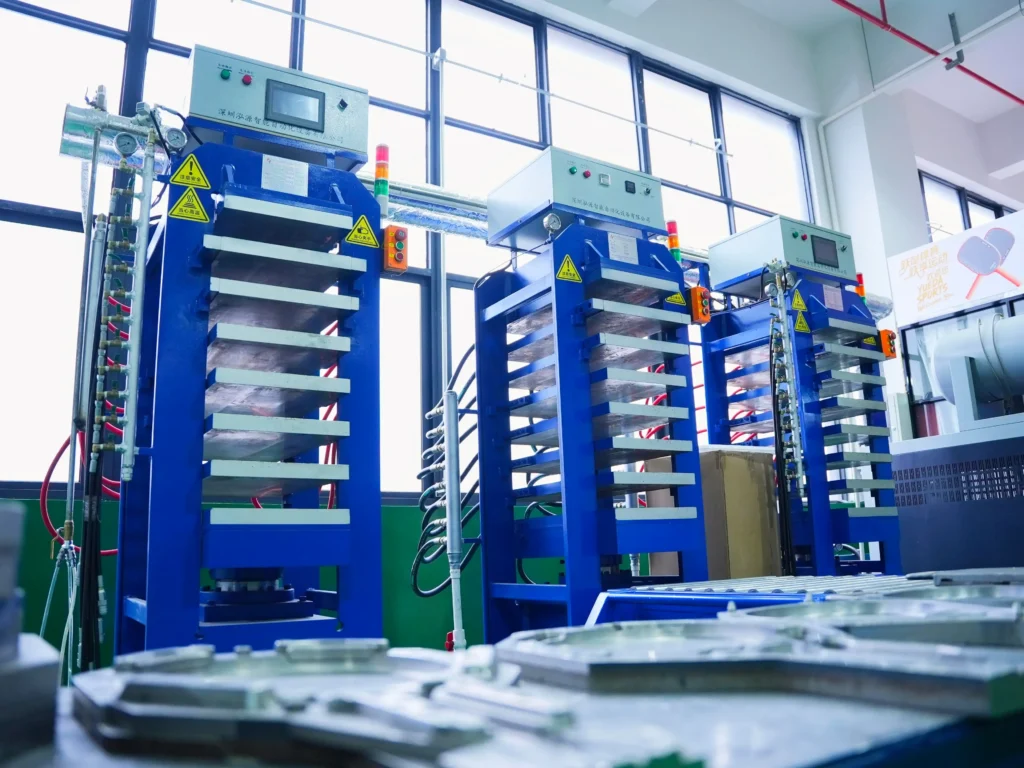
The pre-formed assembly is loaded into a heated mold and pressed at 185°C for a full 35-minute cycle. The heat fully cures the prepreg resin, fuses face to core, and produces the unibody structure that gives thermoformed paddles their signature stiffness and pop.
If temperature is too low or the cycle too short, the resin under-cures—the paddle feels right on day one but starts showing micro-cracks at 3,000 hits. We log oven temperature and cycle time for every batch.
Step 3 — 360° Full Carbon Fiber Wrap and Unibody Construction
Premium thermoformed paddles use a 360° full carbon fiber wrap, meaning carbon plies extend across the face, around the perimeter, and into the throat. EVA foam is injected into the edge channel before pressing, sealing the core and absorbing impact shock.
The result is a single continuous structure with no glue lines for water, sweat, or impact to pry open. This is why thermoformed paddles resist Delamination far better than older cold-pressed designs.
Step 4 — Multi-Stage Coating, QC, and Assembly
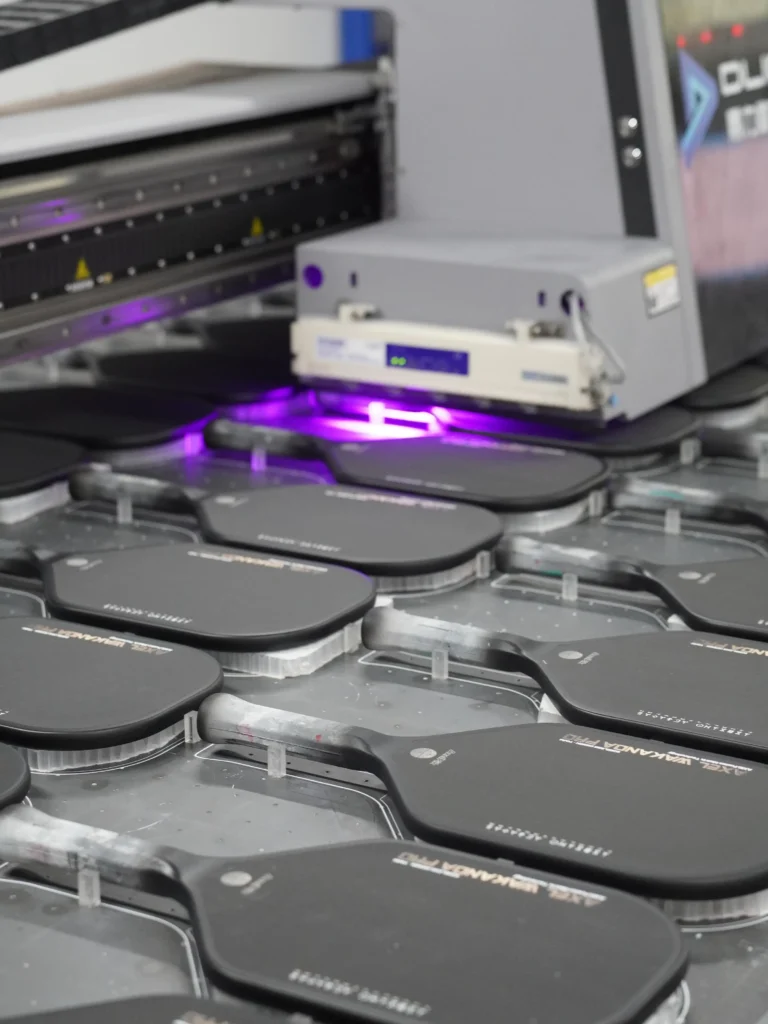
After thermoforming, paddles cycle through deflashing, sandblasting, base coat, mid coat, and top coat with sanding passes between coats. Final stages include UV logo printing, edge guard install (where specified), grip wrap, and BOM verification. Every paddle then passes a pre-shipment final inspection covering weight, balance, visual finish, and hand feel.
Carbon Fiber Grades Decoded: T700, T800, T1000, and 18K Compared
Not every “carbon fiber paddle” is built on the same material grade. The face material drives both the price tier and the play feel.
| Grade | Tensile Strength | Typical Retail Tier | Surface Look | Best For |
|---|---|---|---|---|
| T300 | ~3,530 MPa | Entry / promo | Painted or coated | Beginners, school programs |
| T700 (Toray) | ~4,900 MPa | Mid to upper-mid ($80–$150) | Raw carbon weave | Intermediate to advanced players, club tournaments |
| T800 | ~5,490 MPa | Premium ($120–$200) | Tighter weave, glossy | Aggressive doubles, fast-hands battles |
| T1000 | ~6,370 MPa | Flagship ($180+) | Fine, high-density weave | Pro tour, sponsored athlete lines |
| 18K Carbon | T700-grade base + 18K tow | Premium aesthetic ($130–$180) | Bold 3D triaxial weave | Brand differentiation, retail shelf appeal |
A higher T-value means higher tensile strength and a stiffer, more responsive feel. K-value (3K, 12K, 18K) refers to the visual weave pattern and surface texture rather than mechanical performance.
T700 is the workhorse of 2026—the carbon fiber pickleball paddle lines we ship to brand owners across North America and Europe overwhelmingly use T700 raw carbon faces with PP honeycomb cores. T800 and T1000 are reserved for flagship SKUs where the brand needs a clear premium-tier story.
The 4 Pillars of Batch-to-Batch Consistency
Batch consistency is the single biggest reason wholesalers fire their suppliers. A paddle that plays great in the sample run but drifts in weight, balance, or surface grit at production scale is unsellable. We hold consistency on four pillars.
Pillar 1 — Verified Raw Materials with Lot Traceability
Every roll of T700 prepreg, every PP honeycomb sheet, every resin batch enters our facility with a lot number and a Material Test Certificate. We bind the lot number to the production order, so any quality issue traces back to a specific raw material batch.
Pillar 2 — Standardized Production with Locked Process Parameters
Every paddle SKU has a documented SOP: prepreg layer count, layup angles, mold temperature, press time, sanding grit progression, paint coats. Operators do not vary parameters by judgment; they follow the spec.
Pillar 3 — Professional Testing Equipment for Every Batch
Each production batch is sample-tested on the four lab instruments mentioned above—PBCoR, swing weight, balance, and surface friction. Results log against the SOP target with pass/fail thresholds. Out-of-spec batches do not ship.
Pillar 4 — Multi-Node Manual Inspection by Trained QC Staff
Automation handles the heavy lifting; trained inspectors handle the judgment calls. Five inspection nodes—after layup, after thermoforming, after sanding, after paint, after final assembly—catch defects machines miss: layer misalignment, edge voids, paint orange peel, grip wrap tension.
OEM and ODM Partnership: MOQ, Lead Times, and Customization
Direct factory partnership runs on clear commercial terms. Here is what we offer wholesale and OEM clients:
- MOQ: 50 paddles per SKU for first-time custom orders
- Sample lead time: 3–7 days for blank or logo-printed samples
- Production lead time: 7–15 days for orders under 1,000 pcs; 25–35 days for 5,000+ pcs
- Customization scope: face material (T700 / T800 / T1000 / 18K / Kevlar / titanium hybrid), core thickness (13mm / 14mm / 16mm), shape (elongated / widebody / hybrid), edge construction (thermoformed unibody / cold-pressed), grip, edge guard, packaging
For brand owners building a private label from concept up, our pickleball paddle OEM customization page walks through the full workflow from artwork submission to retail-ready packaging.
Frequently Asked Questions
1. What is a carbon fiber pickleball paddle factory?
A carbon fiber pickleball paddle factory is a manufacturer that produces pickleball paddles with carbon fiber faces and polymer honeycomb cores entirely in-house, from prepreg cutting and layup through thermoforming, painting, QC testing, and final assembly under one roof.
2. How do I catch a factory using 2 layers of carbon fiber when they claim 3?
Ask for a cross-sectioned sample and count the carbon plies under a microscope or magnifier. The industry standard is 3 layers per face (Raw T700 spec: 3 layers of T700; 3K twill spec: 2 layers of T700 + 1 layer of 3K). A 2-layer build saves about one-third of the material cost but loses 20–30% of torsional stiffness and typically begins delaminating at 1,000–2,000 hits. Whenever a “3-layer” claim comes with an unusually low quote, request the cross-section.
3. How do I verify a paddle truly uses Toray T700 carbon fiber and not T300?
Ask the factory for the Toray Material Test Certificate (MTC) with the lot number, the customs import declaration showing T700 grade, and a cross-sectioned sample. For large orders, commission an independent tensile test from SGS or an equivalent lab; T300 will measure around 3,530 MPa, while genuine T700 will measure approximately 4,900 MPa. Visual inspection and hand feel are not enough—lab data is the only reliable evidence.
4. What does a 25,000-hit durability test actually involve?
We mount the paddle on a robotic ball machine and cycle ball impacts at 60–70 mph until either 25,000 hits or first failure. Failure modes tracked include face delamination, edge cracking, and Core Crush (visible dimpling on the face). Premium thermoformed paddles built to spec should clear 25,000 hits without any of those.
5. What is the difference between thermoformed and cold-pressed carbon fiber paddles?
Thermoformed paddles are cured under heat (185°C / 35-minute cycle) and pressure in a single shot, producing a unibody structure with EVA foam injected at the edges. Cold-pressed paddles glue the face to a pre-cut core at room temperature. Thermoformed paddles deliver better stiffness, edge durability, and resistance to delamination; cold-pressed paddles are cheaper to produce and easier for short runs.
6. Are your carbon fiber pickleball paddles USAPA approved?
Yes. Our paddles are engineered to meet USA Pickleball equipment standards, including PBCoR.43 limits, Deflection limits, and dimensional rules. We provide pre-testing data on every sample and support brand owners through the official USAPA approval process for new SKUs.
7. What MOQ and lead time should I expect for a first-time OEM order?
Our standard MOQ is 50 paddles per SKU for first-time custom orders. Samples ship in 3–7 days, and bulk production runs typically complete in 7–15 days for orders under 1,000 pcs. For 5,000+ pcs, expect 25–35 days.
8. Can I visit the factory in person before signing a contract?
Yes. We host wholesale and brand-owner visits at our Hefei facility year-round and can also arrange a real-time video walkthrough within 24 hours of request. Both options let you verify production lines, QC equipment, and material storage before committing.
About Apexonsport
Apexonsport is a China-based pickleball paddle, padel racket, and 22-inch racket manufacturer with 10 years of OEM/ODM experience, serving brand owners across North America, Europe, Australia, and Southeast Asia. Supported by 400+ employees and a monthly capacity of 20,000 units, all paddles are produced in our own facility, from prepreg lay-up to final QC.
For brand owners and wholesalers ready to source from a verified carbon fiber pickleball paddles factory, we offer factory-direct pricing, low MOQs, and the full OEM/ODM development pipeline. Contact our team to request samples or schedule a live factory walkthrough.
— Written by the Apexonsport production team