The best pickleball paddle for spin is one that combines a high-friction face material, a USAPA-compliant textured surface, and a core with enough dwell time to let the ball “load” before release. No single brand wins on this. RPM on the ball comes from how three production variables work together — not from marketing.
At our factory in Hefei, China, we’ve spent the last 10 years engineering paddles for B2B brand owners across North America, Europe, and Australia. This guide breaks down what actually generates spin — from face material chemistry to surface treatment lifespan — so retailers, brand owners, and distributors know exactly what to specify when ordering custom paddles.
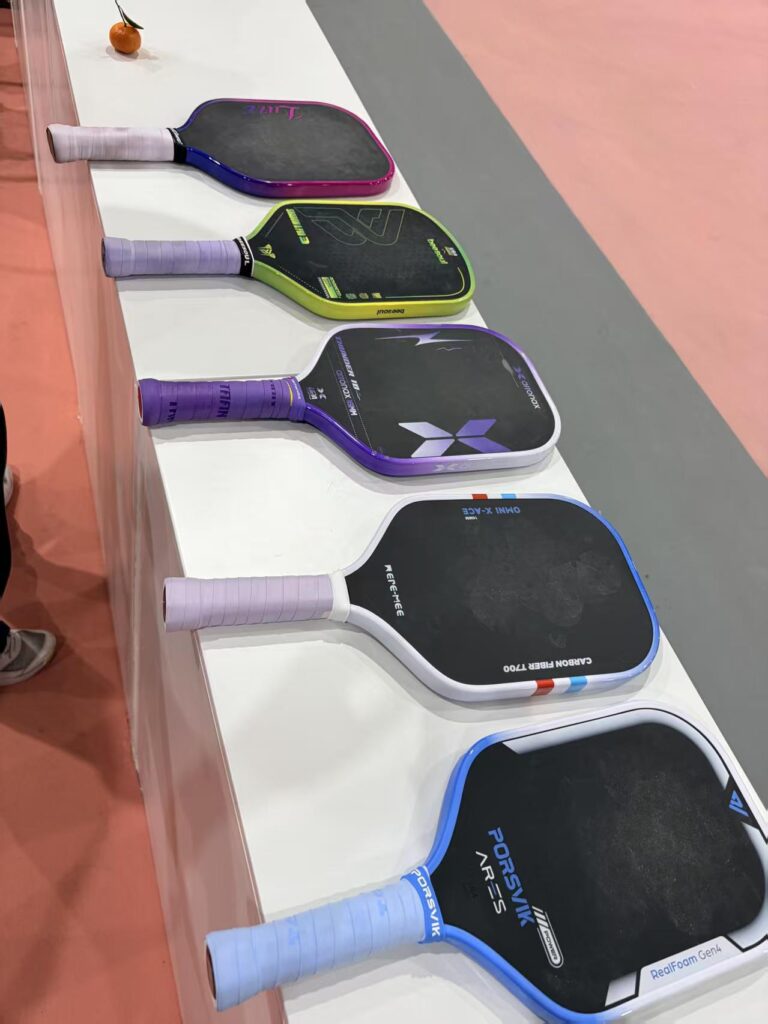
What Makes a Pickleball Paddle Good for Spin? (Quick Answer)
Spin in pickleball is a function of three engineered variables: the coefficient of friction (COF) between paddle face and ball, the dwell time the ball spends compressing against the surface, and the face’s grit retention over its service life.
Top-tier spin paddles in 2026 generate 2,000–2,300 RPM on flat topspin drives under lab conditions. Budget composite paddles average 1,400–1,600 RPM. The difference comes down to face material, surface treatment, and core construction — not the brand name printed on the throat.
USAPA caps the kinetic COF at ≤ 0.1875 and surface roughness at an average of ≤ 40 micrometers. That’s the ceiling. Any paddle above those limits is USAPA Delisted/Banned — a real commercial exposure for brand owners.
The Three Pillars of Spin: Face Material, Surface Texture & Core Dwell Time
Spin doesn’t come from one component. It comes from how face, surface, and core work together at the moment of impact.
How Coefficient of Friction (COF) Translates to RPM on the Ball
Coefficient of Friction (COF) measures how much the paddle face grips the ball during contact. Higher COF means the face drags the ball longer before release, imparting more rotation.
Lab testing shows a roughly linear relationship: every 0.01 increase in COF adds about 100–150 RPM on topspin drives. That’s why hitting the USAPA 0.1875 ceiling — without going over — is the engineering goal for every legitimate spin paddle factory.
Why Dwell Time Matters as Much as Surface Grit
Dwell Time is the milliseconds the ball stays in contact with the paddle face. Longer dwell time means more time for friction to act, which means more spin.
A 16mm polypropylene honeycomb core gives roughly 4.2–4.6 ms of dwell time. A 13mm core gives 3.4–3.8 ms. The 13mm pops harder but spins less. This is the classic Dwell Time vs. Pop trade-off every paddle engineer manages.
Face Materials Compared: T700 Raw Carbon, Kevlar & Fiberglass for Spin
Face material sets the ceiling for how much spin a paddle can generate. Here’s how four common options compare on our production data:
| Face Material | Typical RPM (new) | Grit Lifespan | Cost Index | Best For |
|---|---|---|---|---|
| T700 Raw Carbon Fiber | 2,100–2,300 | 400–600 hrs | High | Premium spin paddles |
| 3K Twill Carbon | 1,800–2,000 | 300–500 hrs | Medium-High | Mid-tier spin |
| Kevlar / Aramid Weave | 1,700–1,950 | 500–700 hrs | High | Soft-touch spin |
| Fiberglass Composite | 1,400–1,700 | 200–350 hrs | Low | Entry-level paddles |
T700 Raw Carbon Fiber — The Spin Industry Standard
T700 Raw Carbon Fiber (RCF) is the 2026 industry benchmark for spin paddles. Its uniform weave creates micro-bumps across the entire face. That uniformity means consistent grip across the sweet spot — not just at the center.
T700 is produced by Toray Industries. The “T700” grade refers to its tensile strength rating of 4,900 MPa. For paddle production, we typically use 3K twill or 12K twill prepreg layups, then strip the resin film to expose the raw fiber surface.
Brand owners specifying RCF should know: not all “raw carbon” is real T700. Some factories use lower-grade carbon and market it as RCF. Always ask for Toray mill certificates. Our carbon fiber pickleball paddle production line uses verified Toray T700 prepreg with traceable lot numbers.
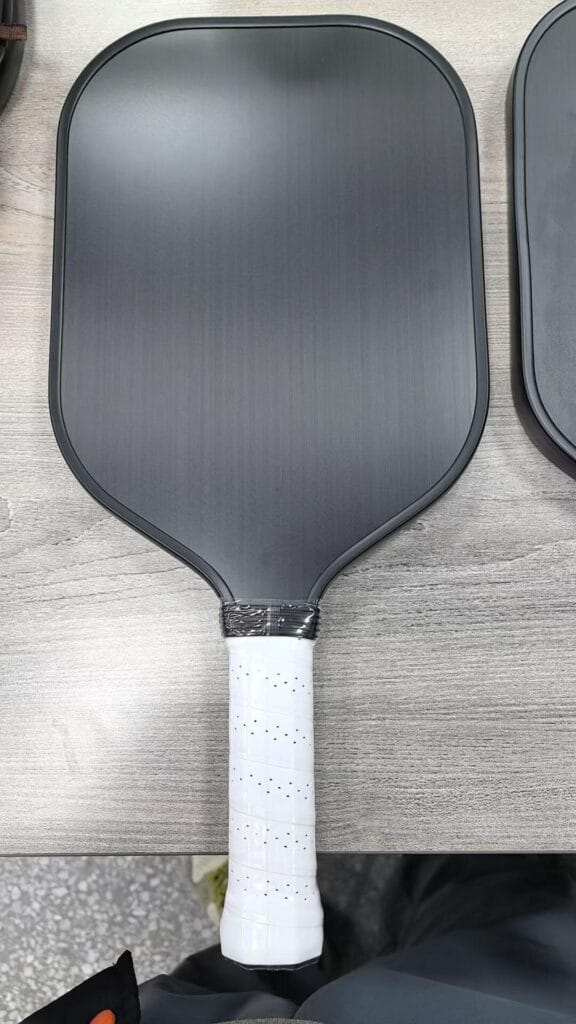
Kevlar & Aramid Weaves — When Softer Touch Pays Off
Kevlar & Titanium Weaves are gaining traction for players who want spin without the harsh, stiff feel of pure carbon. Kevlar’s aramid fibers absorb more vibration, so the ball “dwells” slightly longer before release.
Pure Kevlar faces generate slightly less initial RPM than T700, but grit lifespan runs 20–30% longer in field testing. For brands targeting intermediate players who play four or more times per week, Kevlar is worth the price premium.
Fiberglass & Hybrid Composites — The Budget Spin Option
Fiberglass faces produce more pop but less spin. The fiber structure is wider and smoother than carbon. This works for entry-level paddle lines priced under $40 retail, but Grit Wear sets in fast — typically within 200 hours of moderate play.
Hybrid faces like carbon-aramid-carbon (CAC) split the difference. They’re common in Gen 4 / Gen 5 Pickleball Paddles targeted at intermediate players.
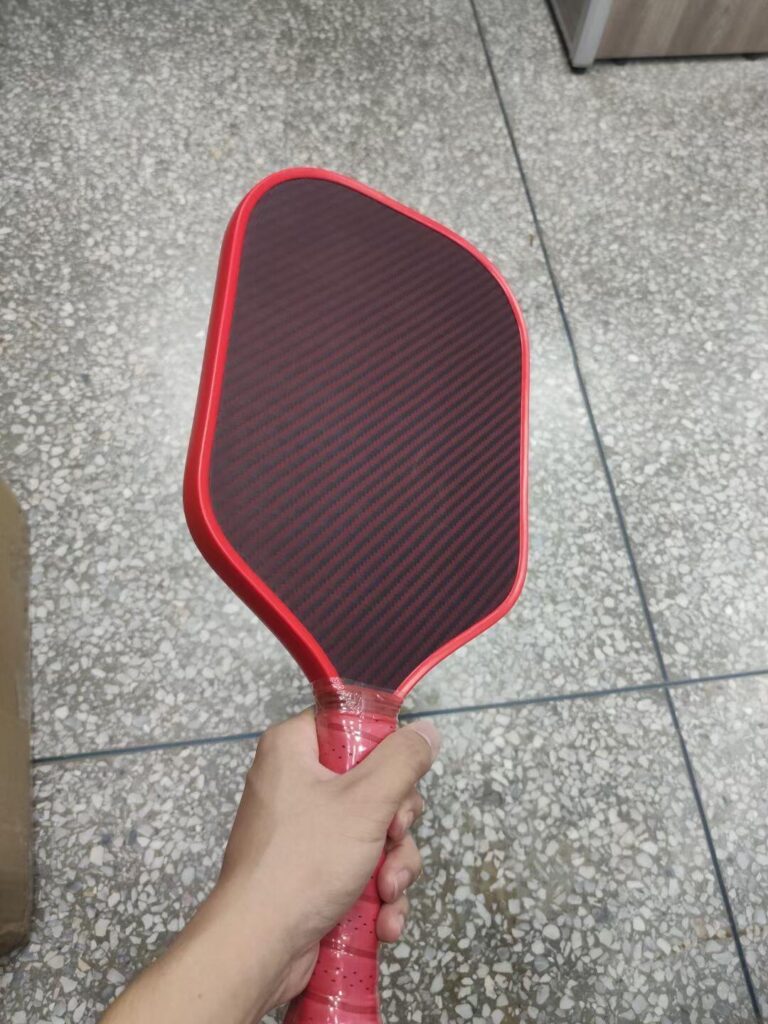
Surface Treatments That Drive Spin (And How Long They Last)
Same face material, different surface treatment, very different spin numbers. This is where factories actually differentiate.
Peel-Ply Surface — Highest Initial RPM, Moderate Lifespan
Peel-ply is a polymer fabric pressed onto the carbon prepreg during thermoforming. When peeled off after curing, it leaves a precise micro-textured imprint on the raw carbon.
Peel-ply surfaces deliver the highest initial COF — typically 0.180–0.185, right under the USAPA ceiling. RPM holds steady through the first 300 hours, then drops about 15% by the 600-hour mark.
Sand-Blasting — Consistent Texture, Longer Wear Life
Sand-blasting uses pressurized abrasive to create uniform micro-pits across the face. Initial RPM is about 5% lower than peel-ply, but the texture wears down more evenly across the paddle’s service life.
Most Gen 3 / Gen 4 Pickleball Paddles sold by major brands rely on sand-blasting. It’s the most consistent process for batch production at scale.
Particle Printing — Lowest Cost, Faster Grit Loss
Particle printing applies a textured coating (silica or polymer particles) over a smoother face. Initial spin numbers can look impressive, but the coating wears off quickly — sometimes within 150 hours.
We avoid this method for our wholesale lines. Loss of Spin complaints from end users hit brand reputation hard.
Our biggest headache with past suppliers was the spin texture wearing off quickly. With ApexonSport, the surface friction on every single paddle in our recent batch was identical and strictly USAPA-compliant. The grit is truly built into the raw carbon, not just sprayed on. That’s the consistency we need to scale.” — Founder of a Premium Pickleball Brand
Core Construction & Dwell Time: How Honeycomb Density Shapes Spin
The face creates friction. The core controls how long that friction has to act.
13mm vs 16mm Core — The Dwell Time Trade-off
| Core Thickness | Dwell Time | Pop / Power | Spin Potential |
|---|---|---|---|
| 13mm Polypropylene | 3.4–3.8 ms | High | Lower |
| 14mm Polypropylene | 3.8–4.2 ms | Medium-High | Medium |
| 16mm Polypropylene | 4.2–4.6 ms | Medium | Higher |
For spin-focused paddle lines, we recommend 16mm cores in polypropylene honeycomb (the standard MPP — micro polypropylene). Some premium models combine MPP + EVA or EPP + EVA in the perimeter for extended dwell time without sacrificing structural rigidity.
Thermoformed Unibody & Foam-Injected Walls (Gen 3 / Gen 4 Construction)
Thermoformed unibody construction wraps the face and core in a single heat-pressed shell. Foam-injected walls (typically EVA) line the perimeter, sealing the honeycomb and extending Sweet Spot Optimization.
This construction style is standard for premium paddles today. We produce thermoformed paddles on dedicated lines at our facility — full specifications are on our thermoformed pickleball paddle production page. Deflection Limits under USAPA apply to thermoformed builds as well, and overbuilt foam walls can fail compliance testing.
USAPA Spin Compliance: The Hidden Ceiling on Every Spin Paddle
This is what most retail blogs don’t tell you. Every spin-focused paddle has a ceiling — set by USA Pickleball.
Current limits, according to USAPA 2024 equipment standards:
- Kinetic Coefficient of Friction: ≤ 0.1875
- Surface Roughness (Rt): ≤ 40 micrometers, averaged across 6 measurement directions
- Reflection: paddle surface must not exceed defined gloss thresholds
- Deflection: average paddle deflection ≤ 0.005 inches under load
A paddle exceeding any of these limits gets pulled from approved tournament use. Brand owners caught selling USAPA Delisted/Banned paddles face returns, chargebacks, and serious reputation damage.
We run pre-certification testing in-house before any custom paddle goes to USAPA. Getting the COF right is the hardest part — high enough to compete on spin, but never over 0.1875. Our production targets 0.182–0.184 — a deliberate 2–5% safety margin. Full standards are at the USAPA official equipment page.
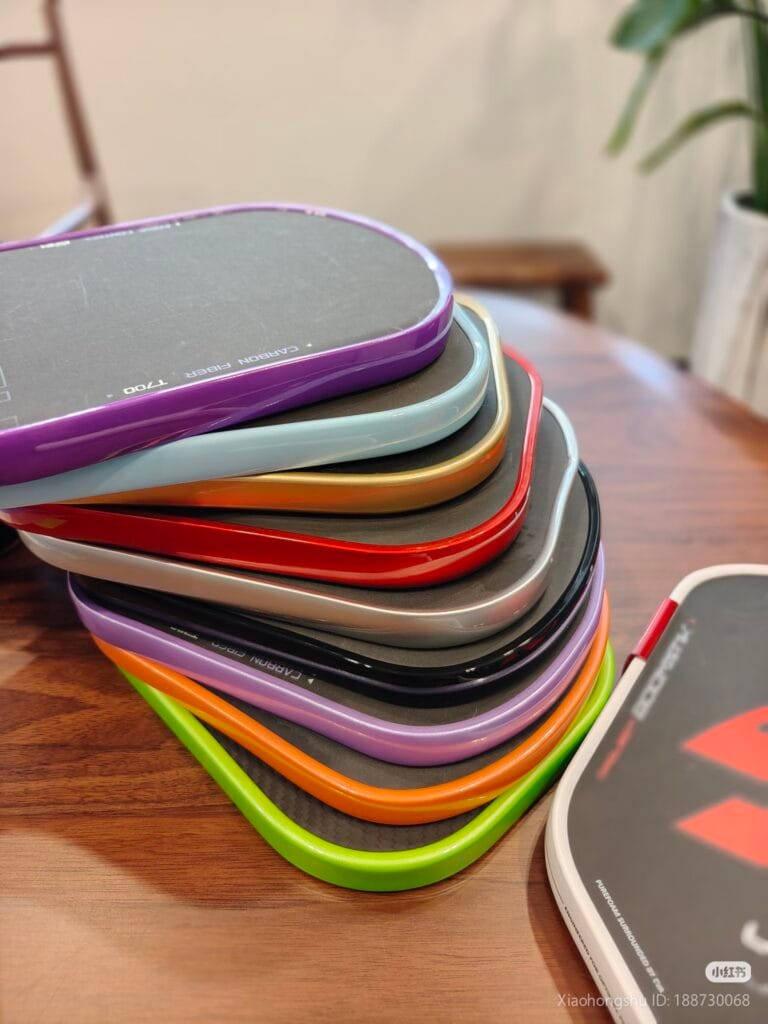
A Manufacturer’s Checklist: What to Specify When Ordering Spin-Focused Paddles
For brand owners and distributors ordering custom spin paddles, these are the specs to lock down in your purchase order:
- Face material grade: Toray T700 RCF with mill certificate
- Surface treatment: peel-ply or sand-blast (specify which)
- Target COF range: 0.180–0.184
- Core type and thickness: 16mm polypropylene honeycomb (MPP)
- Edge construction: thermoformed unibody with EVA foam walls
- Weight tolerance: ±0.2 oz per paddle
- Pre-shipment QC: COF spot test on 5% of every batch
- USAPA compliance documentation: provided with each shipment
Recently, a prospective client asked us to use cheap particle spray to increase spin and cut costs. We refused. Spray-on textures degrade after a few games and risk failing USAPA roughness tests.
We stick to authentic T700 raw carbon with a Peel Ply texture. It requires longer thermoforming times in the mold, but it creates a permanent, compliant friction surface. We lost a quick, cheap deal that day, but gained a long-term partner when they realized real engineering always wins.
For brand owners ready to scope a spin-focused product line, our custom pickleball paddle program supports MOQs from 50 pcs, sample production in 3–7 days, and standard bulk lead times of 7–15 days.
Frequently Asked Questions
What is the best pickleball paddle for spin?
The best pickleball paddle for spin combines a T700 raw carbon fiber face, a peel-ply or sand-blasted textured surface within USAPA limits (COF ≤ 0.1875), and a 16mm polypropylene honeycomb core for extended dwell time. Brand and price matter less than these three specifications.
How many RPM should a good spin paddle generate?
Premium spin paddles produce 2,000–2,300 RPM on lab-tested topspin drives. Mid-tier paddles range 1,700–1,900 RPM. Anything below 1,500 RPM is not engineered for spin.
Does a 13mm or 16mm core spin more?
16mm cores spin more. They give the ball roughly 0.6–0.8 ms longer dwell time, which translates to higher RPM. 13mm cores trade spin for raw power.
How long does the grit on a raw carbon paddle last?
T700 raw carbon with peel-ply treatment retains 85% of initial spin through 300 hours of play, dropping to about 70% by 600 hours. Sand-blasted surfaces wear more evenly. Particle-coated surfaces drop fastest.
Is raw T700 carbon better than 3K twill for spin?
Raw T700 generates higher initial RPM because the exposed fiber creates more micro-friction points. 3K twill is smoother and pairs better with applied surface coatings. Both are legitimate construction choices for different paddle tiers.
Are Kevlar paddles legal under USAPA rules?
Yes. Kevlar and aramid-weave paddles are USAPA-approved as long as they meet the same COF, roughness, and deflection limits as carbon paddles.
Can I customize a spin paddle for my brand?
Yes. Full OEM/ODM customization covers face material, surface treatment, core thickness, paddle shape, edge construction, grip, and logo or graphics. Specifications determine performance — including spin behavior.
What’s the MOQ for OEM spin paddles?
At our factory, MOQ starts at 50 pcs per design. Sample production runs 3–7 days; bulk production runs 7–15 days for standard configurations.