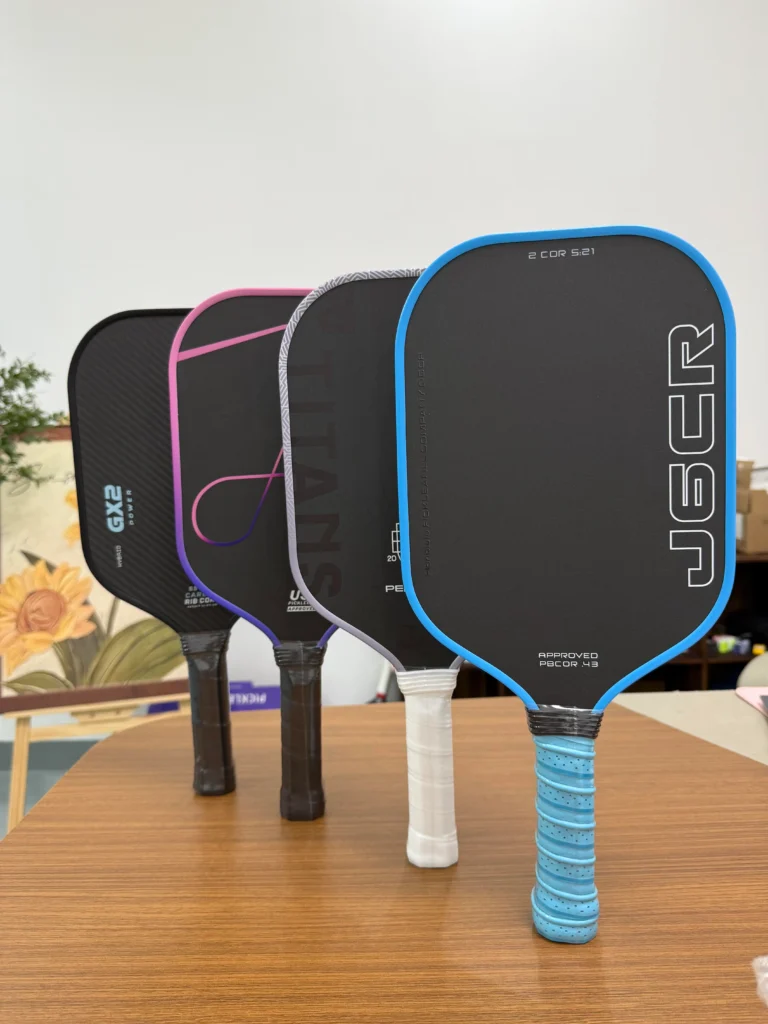
Blank pickleball paddles are unbranded, production-grade paddles built on the same carbon fiber faces and polymer honeycomb cores as the printed paddles you see on Amazon—they simply ship without a logo, leaving the branding step to you.
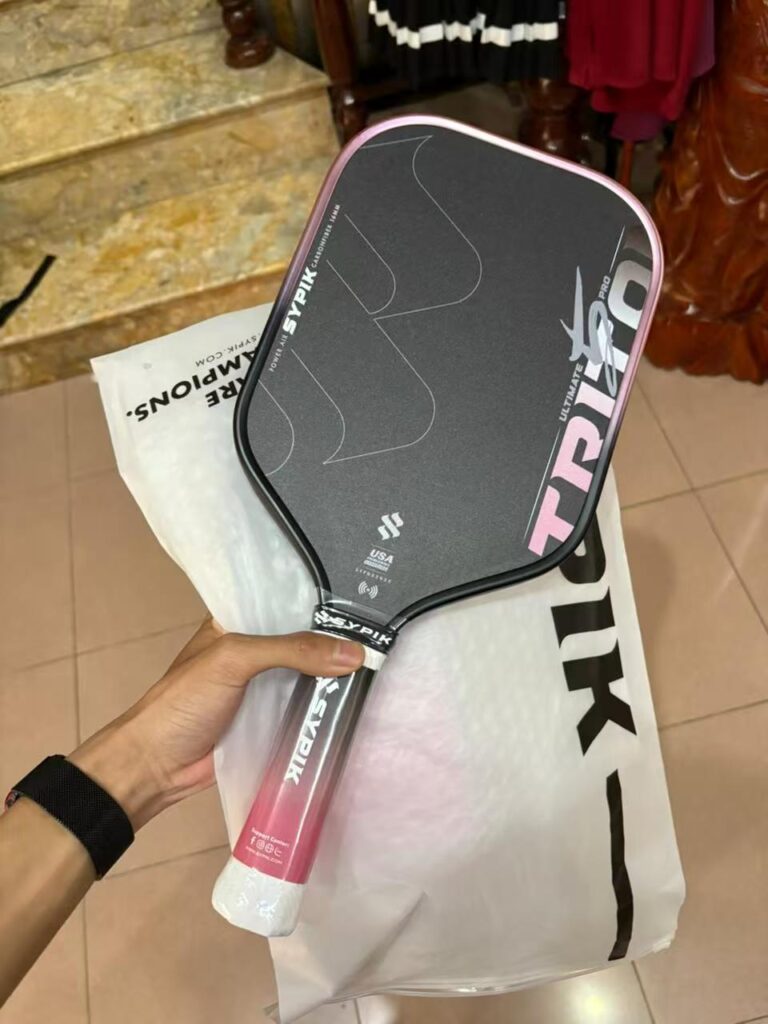
For brand owners launching a private label, distributors testing a new SKU, or promotional product companies prepping a corporate event, blank paddles are the smartest entry point into the pickleball market. You skip the design lock-in, the printing tooling, and the long custom lead times—and you keep the option to print your final logo only after the market tells you what’s working.
This guide explains what a real blank paddle is (and is not), what’s inside one, which printing methods are compatible, and how to use a phased procurement plan to grow from 50 test units to a 1,000+ unit retail program without burning capital on the wrong design.
What Are Blank Pickleball Paddles?
A blank pickleball paddle is a fully manufactured, retail-grade pickleball paddle—carbon fiber or fiberglass face, polymer or foam-filled honeycomb core, edge guard, grip—that leaves the factory without a printed logo, graphic, or brand name. Everything else (materials, construction, USAPA compliance) is identical to a printed paddle from the same production line.
The reason this matters: a blank paddle is not a “discount” or “rejected” paddle. It comes off the same prepreg lay-up, the same 185°C thermoforming press, and the same QC station as a branded paddle. The only step it skips is the UV-printing or sanding-finish branding stage.
Disambiguation — important. Two very different products share the term “blank”:
- Production-grade blank paddles (this guide): real composite paddles with carbon fiber or fiberglass faces and polymer honeycomb cores. MOQ typically 50 units, wholesale pricing $15–$45, suitable for tournament play and retail sale.
- Sublimation blank paddles (NOT this guide): plywood DIY paddles with a sublimation coating, designed for craft printing at home. Sold on Hobby Lobby, Etsy, and Amazon for $5–$15 each. These are craft products—they do not meet USAPA standards and will not perform at retail-grade level.
If you are sourcing for a private label brand, a retail program, or a club / event supply, you want the production-grade version. Everything below assumes that context.
Why Smart Brand Owners Start with Blank Paddles
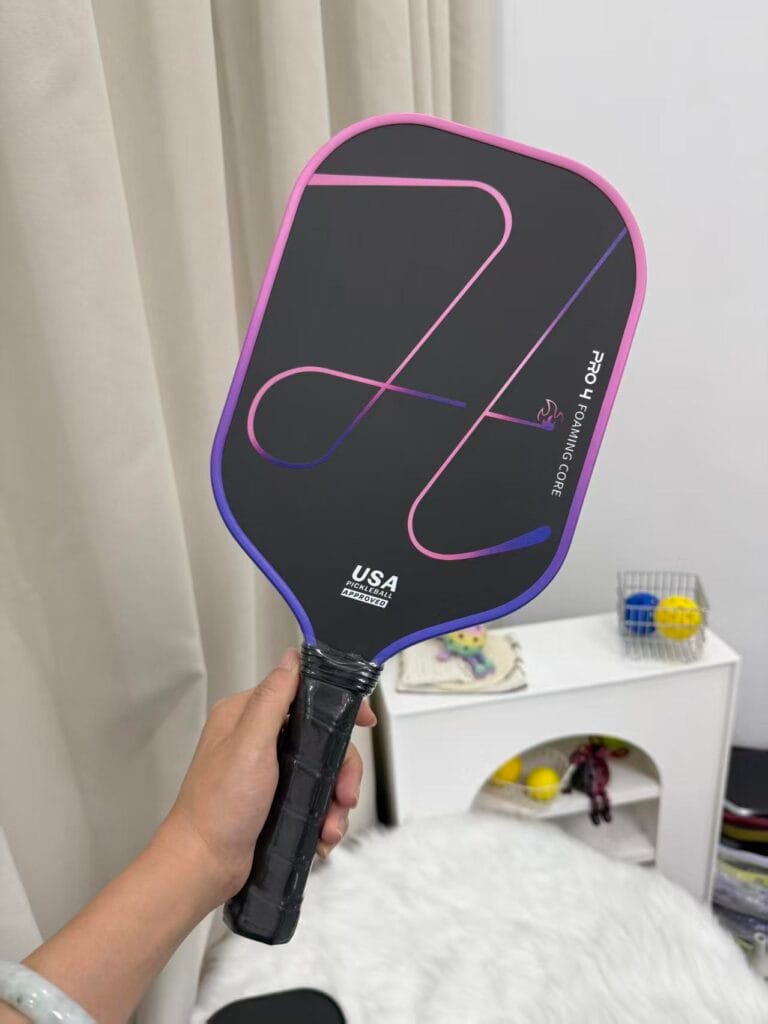
Blank paddles look like a “downgrade” until you run the math on what full custom actually costs in time, capital, and design risk.
Market Validation Before Full Custom Investment
The single biggest reason new private label brands fail: they spend $8,000–$15,000 locking in a custom design—graphics, packaging, branding—before the market has told them anything. A blank paddle program lets you test demand with $1,000–$2,000 of inventory, get real Amazon and Shopify data on conversion and return rates, and commit to full custom only after the demand signal is real.
3–4× Faster Lead Time vs Custom Paddles
Skipping the printing and sample-approval cycle compresses lead time dramatically. On our line, blank paddles ship in 3–5 days for samples and 7–10 days for orders under 1,000 pcs, compared to 7–15 days for fully custom orders. For brands chasing a seasonal window—holiday gifting, corporate team-building season, summer tournament prep—those extra two weeks are often the difference between landing the season and missing it.
Flexible Re-Branding Without Re-Tooling
If you sell into the promotional-products market or supply corporate clients, the same batch of blanks can be printed with dozens of different logos as orders come in. You hold one inventory SKU and print on demand at a local UV shop. Custom paddles, by contrast, lock you into one logo per production run.
The Materials Matrix: What’s Actually Inside a Blank Paddle
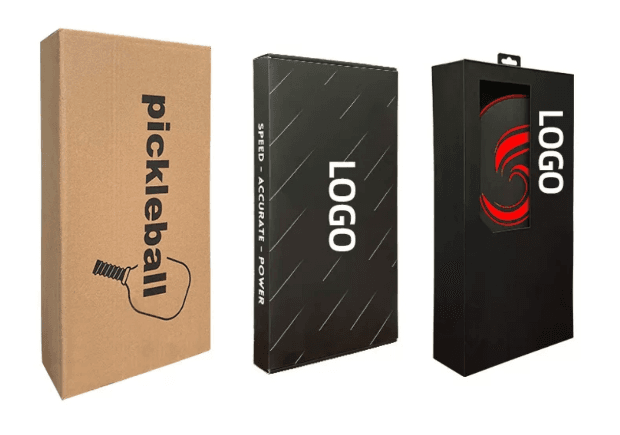
This is where most first-time buyers get burned: they assume “blank” means “low end” and stop asking about materials. In reality, blank paddles span the same material grades as printed paddles—and the price difference between the cheapest and most premium blanks is over 3×.
Face Material — 4 Standard Options
| Face Material | Tensile Strength | Wholesale Tier | Best For |
|---|---|---|---|
| Fiberglass | ~2,800 MPa | Entry ($8–$20) | Beginner club paddles, school programs, promotional |
| 3K Twill Carbon | ~3,800 MPa | Mid ($22–$32) | Intermediate retail, mid-tier private label |
| Toray T700 Raw Carbon | ~4,900 MPa | Premium ($27–$40) | Tournament-grade private label, advanced players |
| Kevlar Hybrid | varies by weave | Specialty ($33–$45) | Differentiated brand positioning, aramid-spin tech |
T700 raw carbon is the workhorse for mid-to-premium private label programs in 2026. Our carbon fiber pickleball paddle lines overwhelmingly ship as either raw T700 blanks or 3K-twill blanks, depending on the brand’s target retail tier. If you want full traceability on the carbon stock, request a Material Test Certificate from Toray Industries carbon fiber tied to your production lot number.
Core System — 4 Industry-Standard Choices
The core determines play feel as much as the face material does. We supply blanks with four core systems:
- PP honeycomb — classic polypropylene core, soft feel, longer dwell time, control-oriented
- PP honeycomb + EVA edge injection — added impact damping and edge durability
- EPP + EVA — Expanded Polypropylene with EVA fill, softer pop, control-flow players
- MPP + EVA — Modified Polypropylene with EVA fill, more pop with retained durability, aggressive doubles
We covered the full manufacturing detail for each core system—including the 185°C thermoforming cycle and the 3-layer carbon fiber lay-up standard—in our deep-dive on the carbon fiber pickleball paddles factory workflow. If you are deciding which core fits your brand’s positioning, that piece pairs directly with this one.
Why “Blank” Doesn’t Mean “Cheap”
Same prepreg, same lay-up, same press, same QC lab, same final-inspection station. The blank paddle and the printed paddle are produced on the same line, by the same operators, against the same SOP. The only difference is whether the final UV-printing step runs or not.
What this means for sourcing: when you compare two suppliers’ blank paddle quotes and one is 30% cheaper, the difference is almost never “they sell blanks cheaper than custom.” It is almost always a lower carbon grade, fewer carbon layers, or a thinner core. Ask for the spec sheet on every blank quote—face material grade, layer count, core type, and core thickness in mm.
Printing Compatibility — Which Methods Work With Which Blank Surfaces
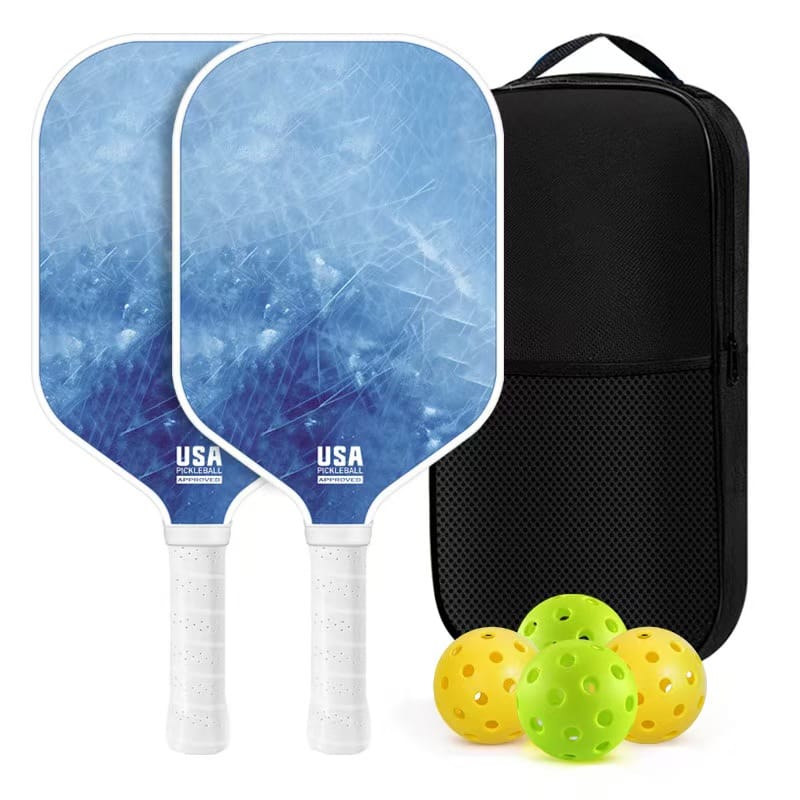
The single most common mistake first-time buyers make: ordering blanks with a raw carbon face, then sending them to a sublimation print shop. The result is a $1,500 batch of paddles with a smudged, unsellable logo. Here is how to avoid that.
UV Printing — The Industry Workhorse
UV printing uses UV-cured inks deposited directly on the paddle surface. It handles full-color graphics, photographic detail, and dense brand artwork. It runs on essentially every production-grade blank surface—fiberglass, 3K twill, raw T700, Kevlar. This is the method roughly 90% of B2B private label paddle programs use, and it is what most local print shops will offer.
Sanding Finish on Top of UV — For Grit + Logo Coexistence
Premium 2026 paddles often combine a printed logo with a textured grit surface for spin. The workflow: UV-print the logo first, then apply a fine sanding spray over the top. The result is a paddle that displays brand graphics clearly while still grabbing the ball for spin. This is what most tournament-grade private label SKUs do today.
Hot Stamping & Foil — For Small, Premium Logos
Hot stamping presses a metallic or single-color foil into the paddle surface. It is ideal for small logos with simple, clean lines—a brand mark, a wordmark, a tournament insignia. It does not handle full-color or gradient graphics. Use it for the premium “less is more” brand aesthetic, not for full-face designs.
Why Sublimation Fails on Production Blanks
This is the one industry-insider point most B2B suppliers do not warn buyers about: sublimation requires a polyester-coated surface to bond with. A production-grade carbon fiber blank has a UV-cured resin or clear coat—not a sublimation coating. Heat-pressing a sublimation transfer onto a raw carbon blank produces a faded, smudged, or completely failed transfer. The plywood paddles sold at craft retailers come pre-coated specifically for sublimation; production-grade carbon blanks do not.
Printing Method Compatibility Matrix:
| Blank Surface | UV Printing | Sanding Finish on UV | Hot Stamping | Sublimation |
|---|---|---|---|---|
| Fiberglass blank | ✅ Recommended | ✅ Works | ✅ Works | ⚠️ Limited (special coat only) |
| 3K Twill carbon blank | ✅ Recommended | ✅ Recommended | ✅ Works | ❌ Not compatible |
| T700 raw carbon blank | ✅ Recommended | ✅ Recommended | ✅ Works | ❌ Not compatible |
| Kevlar hybrid blank | ✅ Works | ✅ Works | ⚠️ Limited | ❌ Not compatible |
The 3-Phase Procurement Roadmap for New Private Label Brands
Most new brands either over-commit to a 1,000-unit custom order on day one and burn capital, or under-commit and never reach scale. Here is the phased path we recommend to first-time private label clients.
Phase 1 — Market Test (50 Blank Units, Self-Printed)
Capital: ~$1,000–$2,000
Timeline: 7–10 days from order to first marketplace listing
Order 50 blank paddles at your target spec. We recommend T700 raw carbon + PP honeycomb (or PP+EVA) for entry-level testing. Take them to a local UV-printing shop, apply your draft logo, list on Amazon, Shopify, or Etsy. Track three metrics over 30 days:
- Click-through rate on listing
- Conversion rate from product page
- Return rate and reason codes
You are not trying to break even at this stage—you are buying market data. If the data is good, move to Phase 2. If not, change the design before scaling.
Phase 2 — Validation (200 Units, Supplier-Printed Initial Logo)
Capital: ~$3,000–$5,000
Timeline: 10–15 days from final logo approval
Move printing in-house at the factory. Lock in your final logo and have us print your batch at production scale—this gives you consistent, professional output and a unit-economic preview of full custom pricing. Use this batch to validate two things:
- The repeat purchase rate (Amazon “frequently bought together,” Shopify customer LTV)
- The review quality and durability feedback after 30–60 days of real play
Phase 3 — Scale (1,000+ Units, Full Custom Production)
Capital: $15,000+
Timeline: 25–35 days end-to-end
Once Phase 2 confirms the design and the market, move to full custom: lock the paddle shape, core thickness (13mm / 14mm / 16mm), handle, edge guard color, retail packaging, and barcoding. This is where you transition from “validated SKU” to “brand asset.”
Blank vs Custom Paddle: Lead Time, Pricing, and Decision Matrix
| Dimension | Blank Paddle | Fully Custom Paddle |
|---|---|---|
| MOQ | 50 per SKU | 100–200 per SKU |
| Wholesale price | $15–$45 | $18–$52 |
| Sample lead time | 3–5 days | 7–14 days |
| Production lead time (<1,000 pcs) | 7–10 days | 7–15 days |
| Customization scope | Material, core, shape | Everything + graphics + packaging |
| Best for | 0–500 paddles/month brand stage | 1,000+ paddles/month brand stage |
The decision is mostly volume-driven. If your brand is still under 500 paddles per month, blanks plus local printing protect your capital. Once you cross 1,000 paddles per month consistently, the per-unit savings on factory-printed custom paddles outweigh the flexibility benefit of blanks.
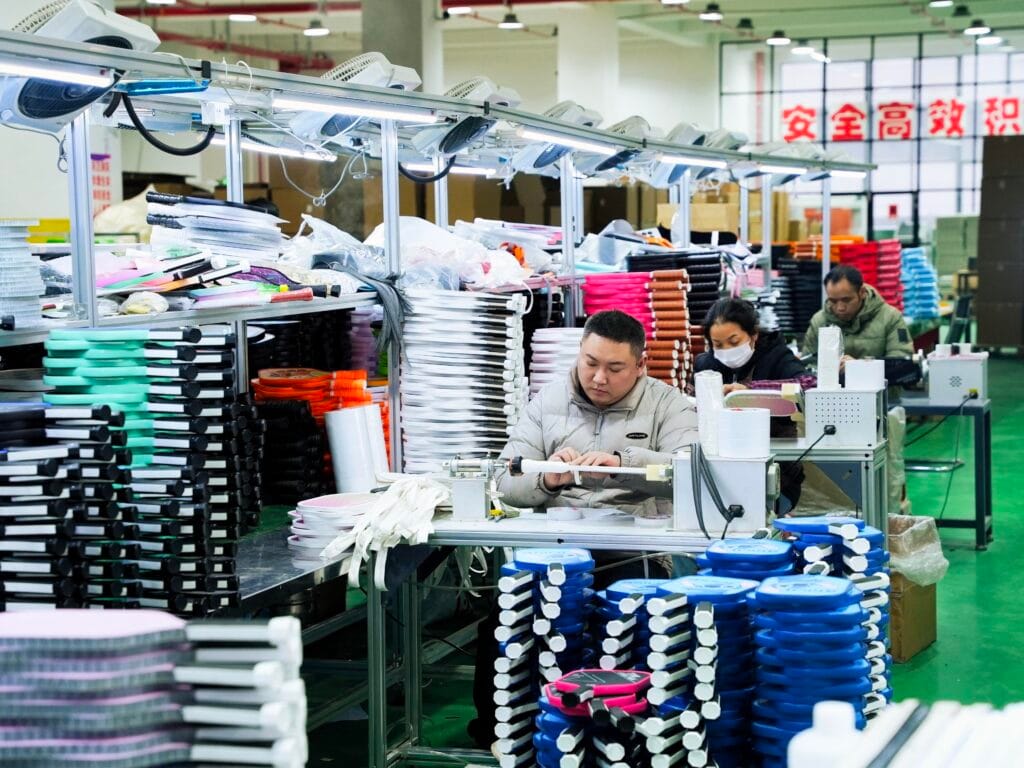
OEM Partnership Terms — MOQ, Lead Times, and What’s Customizable
Direct factory partnership runs on clear commercial terms. Here is what we offer wholesale and OEM clients on blank paddle orders:
- Blank MOQ: 50 paddles per SKU
- Custom MOQ: 100 paddles per SKU (graphics + branding included)
- Sample lead time: 3–5 days for blanks; 7–14 days for printed samples
- Production lead time: 7–10 days under 1,000 pcs; 25–35 days for 5,000+ pcs
- Customization scope on blanks: face material (fiberglass / 3K twill / T700 / Kevlar hybrid), core system (PP / PP+EVA / EPP+EVA / MPP+EVA), core thickness (13mm / 14mm / 16mm), shape (elongated / widebody / hybrid), handle length, edge guard color, grip wrap, packaging
For brand owners ready to move from blank to fully branded production, our custom pickleball paddle OEM page walks through the full workflow from artwork submission to retail-ready packaging.
Frequently Asked Questions
Q1: What are blank pickleball paddles?
Blank pickleball paddles are unbranded, production-grade pickleball paddles—carbon fiber or fiberglass face, polymer honeycomb or foam-filled core, edge guard, and grip—that ship from the factory without a printed logo, graphic, or brand name. They are produced on the same line and to the same QC standard as branded paddles, and are designed for private label brands, wholesalers, and promotional companies that apply branding later.
Q2: What’s the difference between a blank paddle and a sublimation blank paddle?
A production-grade blank paddle is a real composite paddle with a carbon or fiberglass face and a polymer honeycomb core, built for tournament play and retail sale at $15–$45 wholesale. A sublimation blank paddle is a plywood DIY paddle with a sublimation-ready coating, sold on craft platforms like Hobby Lobby and PYD Life for $5–$15. Sublimation blanks are craft products and do not meet USAPA standards—they are for personal printing projects, not for retail or competitive play.
Q3: Is a blank paddle lower quality than a printed paddle?
No. A blank paddle from a production-grade factory comes off the same prepreg lay-up, the same 185°C thermoforming press, and the same QC inspection as a printed paddle from the same line. The only difference is whether the UV-printing or sanding-branding step runs. Material grade, layer count, and core construction are identical—quality is determined by the spec you order, not by whether the paddle is printed.
Q4: What’s the minimum order quantity for blank paddles?
Our blank paddle MOQ is 50 paddles per SKU. Custom-printed paddles start at 100 paddles per SKU. Lower quantities are possible for paid sample runs (typically 5–10 units).
Q5: Can I print my logo on the paddles after I receive them?
Yes—this is one of the main reasons brands buy blanks. Most local UV-printing shops can handle blank carbon fiber paddles. Recommended methods include UV printing for full-color graphics, hot stamping for small premium logos, and UV + sanding-finish combination for grit-textured paddles. Avoid sublimation transfer on raw carbon blanks; the surface is not sublimation-coated and the print will fail.
Q6: Are your blank pickleball paddles USAPA approved?
Yes. Our blank paddles are engineered to meet USA Pickleball equipment standards, including PBCoR.43 limits, Deflection limits, and dimensional rules. We provide pre-testing data on every sample and support brand owners through the official USAPA approval process when you finalize your branded SKU.
Q7: Can I switch from blank paddles to fully custom paddles later?
Yes—and this is the standard growth path we recommend to private label clients. Most of our brand-owner partners start with 50–200 blank units to validate the market, then transition to full custom at 1,000+ unit volumes. The blank and custom programs share the same production line, so paddle quality and performance stay identical between phases.